
 Allie Agostino
 Iman Ahmed
 Christian Alvarez
 Brianna Barretta
 Kirah D. Cobbs
 Ryan Connelly
 Victoria Corless
 Mary DeRose
 Saira Desai
 Matthew Dietrich
 doogaho
 Dylan Kaminski
 Esmeralda Rivera
 Erin Nevin
 Anthony Bolton
 fourriea
 Jecce Harriott
 jaredkeane
 Sarah Kropinack
 Laura Leonel
 Kayla Lavecchia
 liptack2gostocktonedu
 mary ceceilia
 Matt Cavallo
 Eli Mitros
 Elizabeth Myers
 Tyler Nicosia
 CHARLES OBIRINANWA
 Kollisa Pimentel
 Vincent Rapallo
 Shakila Riaz
 Tori Robbins
 Diamond Rogers
 Kamelea Saitova
 sarahcipkins
 The Argo
 suzannaccook
 Amanda Tague
 Jaedyn Thomson
 Danna Urias
 Breanna Vanaman
 Jennifer Vaneman
 victoriaorlow
 yoneluna
 Zuleika Rodriguez
On Wednesday, April 8, the Science of Life Club organized a Women in STEM Interdisciplinary Panel in the lecture hall in F-111. The program was hosted by Yater Henry, a student of Psychology, and Kris Rolke, a Stockton Alum of Liberal Arts with a minor in Philosophy & Religion and Sustainability. It was moderated by students Marisa Riley, majoring in Biochemistry and Molecular Biology, and Tasfia Khan, majoring in Mathematics and Physics. The panel consisted of five doctoral professors in the STEM field here at Stockton University.
Dr. Susanne Moskalski is an associate professor of Marine Science. Dr. Moskalski received her PhD in Marine Studies from the University of Delaware. She speaks about her experiences with negative self-talk. Despite achieving great success in her life, she dealt with a lot of imposter syndrome. This difficulty ended after she participated in an experiment that helped her understand the root of her issues.
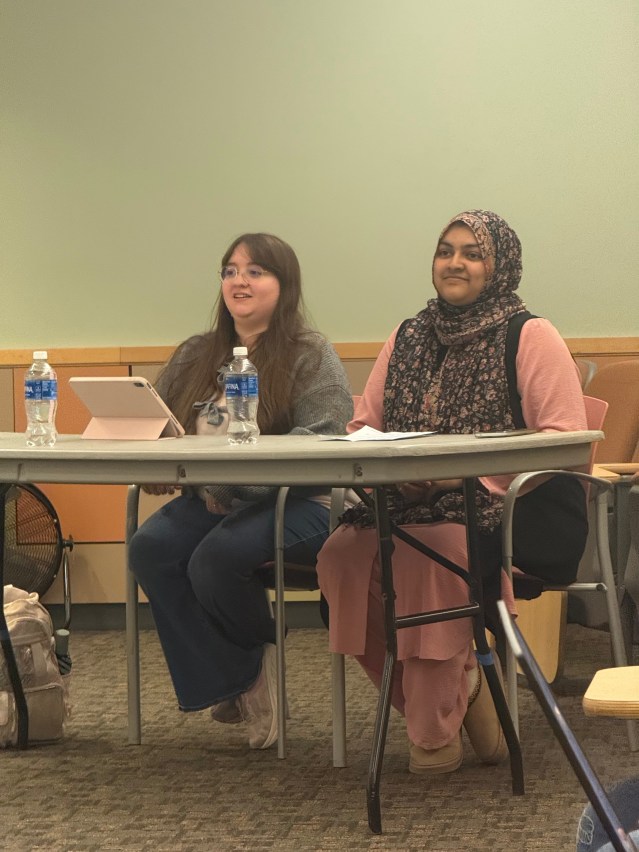
Still, it was difficult to adjust aspects of her life, but she reminded herself, “I’m smart. I have a PhD. I can learn.” Dr. Moskalski shares about free thinking and recommends that students spend time by themselves without any outside distractions. She suggests that students take time to think and focus on what they are thinking. This can lead to a deeper understanding of oneself and the priorities they focus on.
Dr. Judith Vogel is a 1993 Stockton alumni, returning as a Professor of Mathematics. As she worked towards receiving her PhD and becoming a professor, Dr. Vogel explains her journey as spending “my whole life doing what was next until there was no next.” As an individual who is “eager for information,” she broadened her horizons and joined the Maple Project of Stockton University. Now, she also works as the Director of the Maple Grant.
When asked if she had any advice for students, Dr. Vogel says, “I always heard people say to follow your passion. But I didn’t know what my passion was. Now I tell students and women in my life to follow their curiosities, and that will lead to your passion…I live a life of asking questions based on my curiosities, and that allowed me to find my passion.”
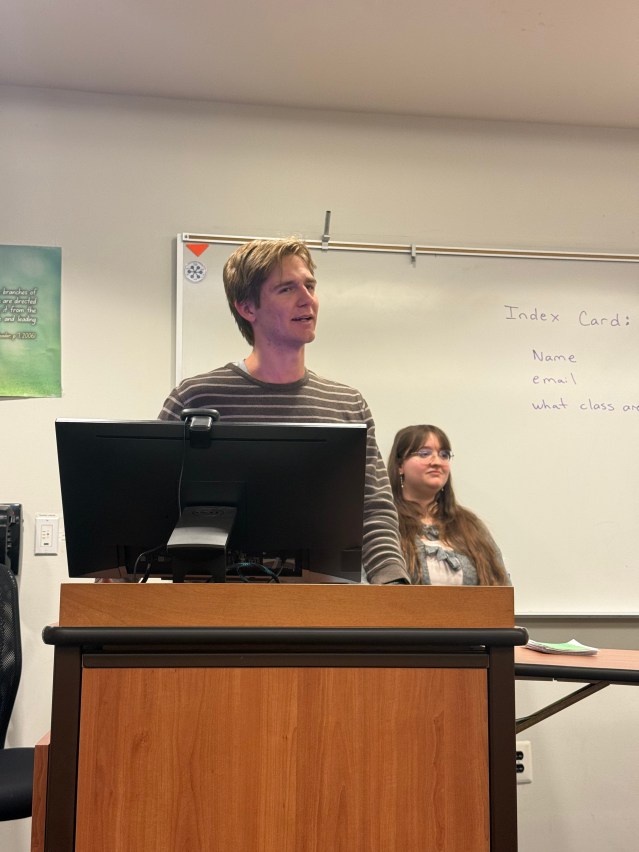
Dr. Elizabeth Pollock is an Associate Professor of Chemistry, who shared that her path into science was not always clear. It wasn’t until she did an exchange program in high school that things shifted for her, and she moved away from the humanities into STEM. What stood out was how she approaches learning. She kept asking, “How can I connect this to other things?” instead of just memorizing information. She emphasized not getting stuck in needing instant results and instead focusing on thinking a few steps ahead. While she noted that being a woman in STEM at Stockton has not been a defining limitation in her experience, she did acknowledge another perception she faces. She spoke about being seen as lesser for being a woman, but sometimes being undervalued for teaching at the undergraduate level. This was a truth that many of the panelists agreed with.
Dr. Suzanne Nezzar, Associate Professor of Mathematics, works in image processing and had a completely different path into teaching than expected. She said she actually didn’t like public speaking, so teaching wasn’t something she originally planned on doing, but when she became a TA in grad school, she realized she loved it. She also spoke about how students limit themselves by only focusing on what they need to pass a class. Instead, she wants students to be more curious and think beyond just grades.
Dr. Emily Kaplitz, Assistant Professor of Computer Science, was very real about what success actually feels like. She said that she thought getting her PhD would be the moment where everything clicked and she “made it,” but that feeling didn’t really last in the way she expected. Instead, she pushed students to think about a different question: not “how do I succeed?” but “how do I get happy?”
Kaplitz talked about how happiness isn’t fixed, and what works for you now might not work later, so you have to keep checking in with yourself. She also shared her experience with dyslexia and how, for a long time, it made her feel like she was the problem, but when her professors during her time as a student at Stockton reframed it as “not an issue,” it completely changed how she saw herself.
Across the panel, a common theme emerged: identity should not be confined to a single role or expectation. Whether discussing career paths, personal struggles, including medical issues, or societal pressures, each speaker reinforced the idea that growth is ongoing and nonlinear.
Categories: Campus Life



 stocktonargo.com