
 Allie Agostino
 Iman Ahmed
 Christian Alvarez
 Brianna Barretta
 Kirah D. Cobbs
 Ryan Connelly
 Victoria Corless
 Mary DeRose
 Saira Desai
 Matthew Dietrich
 doogaho
 Dylan Kaminski
 Esmeralda Rivera
 Erin Nevin
 Anthony Bolton
 fourriea
 Jecce Harriott
 jaredkeane
 Sarah Kropinack
 Laura Leonel
 Kayla Lavecchia
 liptack2gostocktonedu
 mary ceceilia
 Matt Cavallo
 Eli Mitros
 Elizabeth Myers
 Tyler Nicosia
 CHARLES OBIRINANWA
 Kollisa Pimentel
 Vincent Rapallo
 Shakila Riaz
 Tori Robbins
 Diamond Rogers
 Kamelea Saitova
 sarahcipkins
 The Argo
 suzannaccook
 Amanda Tague
 Jaedyn Thomson
 Danna Urias
 Breanna Vanaman
 Jennifer Vaneman
 victoriaorlow
 yoneluna
 Zuleika Rodriguez
The featured guest speaker, Kizito Kalima, spoke on campus on April 7 to talk about his experience during the 1994 Rwandan Genocide against the Tutsi, and his continuing path on reconciling with his past.
The event was conducted by the Sara and Sam Schoffer Holocaust Resource Center at Stockton University, in memory of the 32nd anniversary of the beginning of the Rwandan Genocide (April 6t, 1992.)
The event opened with remarks from Bridge of Faith, a co-sponsor of the event, and Holocaust Resource Center Director Irvin O. Moreno-Rodriguez. He said to the audience of students and guest visitors that Kalima’s choice to speak that day was an act of courage, and that “we should all be challenged by his testimony.”
Kalima, a Tutsi from Rwanda, took the stage and begun with a recollection of the hours between the death of at the time Hutu president Juvénal Habyarimana and the beginning of the Rwandan Genocide.
“We (the Tutsi) will pay a heavy price,” Kalima recalled his mother saying when the president’s death was broadcast on radio. A few days later, aggressors entered Kalima’s home and attempted to capture him, and he watched his family home burst into flames.
The Rwanda Genocide arose from increasing racial tensions between the Hutu and Tutsi, worsened by the country’s colonization by Belgium until the Hutu revolted in 1959. Reports put the death toll of the Tutsi to over 800,000 in 100 days after the beginning of the genocide.
Kalima shared the harrowing details of his capture and escape from “butcher houses” where Tutsi were gathered on Monday and Tuesday to be killed at once. He continued to run from Hutu capture, where he described himself as “turning 15 in the swamps of Rwanda,” Once Kalima had escaped Rwanda, he was between different countries in refugee camps, eventually entering boarding school.
The second half of the presentation was focused on Kalima’s journey of healing, which included Kalima earning a Bachelor’s degree in Criminal Justice in 2005, and the people he spoke with to share his experiences. Kalima thought originally that forgiveness was weakness, and that he could not forgive any of the people who had hurt him during the genocide. His stance changed when he adopted two Rwandan girls at 27, and that experience also changed his perspective on the PTSD he had suffered.
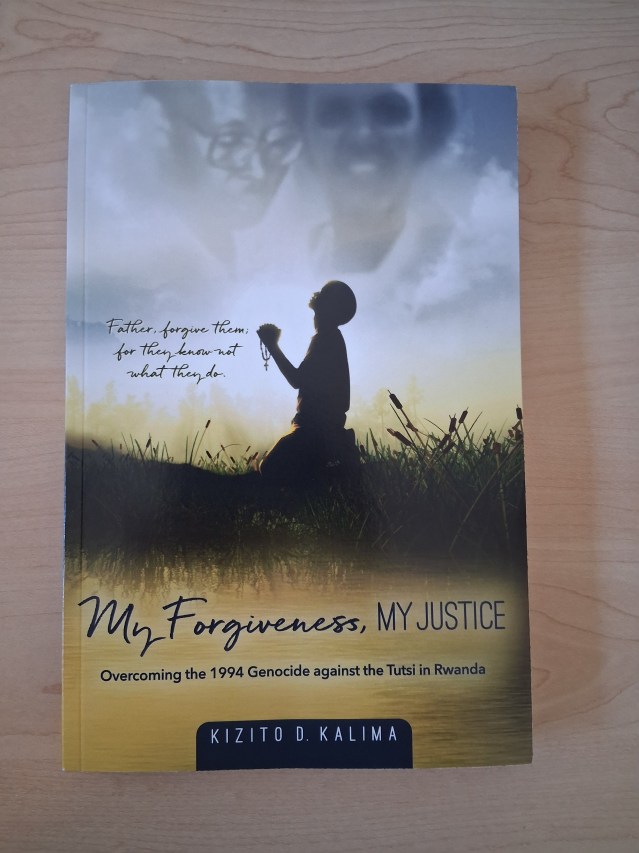
“I did not survive for myself,” Kalima said about his reason for continuing his reconciliation journey. He would go on to open the Peace Center for Forgiveness and Reconciliation, which helps people with similar experiences to Kalima to recover from their past trauma.
During the Question and Answer section, many of the questions asked by the participants centered on feelings of anger and how he could have forgave someone that wronged him, which led to discussions led by Kalima about having access to resources in his community that fostered self-examination and how it could have helped others in the same position as him.
The event concluded with a meet and greet with Kalima, with his final message to the audience to “Accept everyone, we are all human beings.”
Participants who came early received a copy of Kizito Kalima’s book, My Forgiveness, My Justice, and could have Kalima sign the book at the end of the event.
Prior to the event, Moreno-Rodriguez spoke about inviting Kalima onto campus and explained the aims of the event. He commented on Kalima’s message to promote peace and reconciliation, and the importance of listening to testimonies of those who have survived mass atrocities.
“This is not the time to shy away from difficult conversations,” Moreno-Rodriguez said about programs for students to learn about atrocity crimes, “These events are an opportunity for us to learn together.”
The Holocaust Resource Center, in furthering their goal of atrocity crime education and remembrance, is hosting an upcoming event with World War II veteran Sergeant Andrew “Tim” Kiniry on April 16.
Categories: Campus Life



 stocktonargo.com