
 Allie Agostino
 Iman Ahmed
 Christian Alvarez
 Brianna Barretta
 Kirah D. Cobbs
 Ryan Connelly
 Victoria Corless
 Mary DeRose
 Saira Desai
 Matthew Dietrich
 doogaho
 Dylan Kaminski
 Esmeralda Rivera
 Erin Nevin
 Anthony Bolton
 fourriea
 Jecce H
 jaredkeane
 Sarah Kropinack
 Laura Leonel
 Kayla Lavecchia
 liptack2gostocktonedu
 mary ceceilia
 Matt Cavallo
 Eli Mitros
 Elizabeth Myers
 Tyler Nicosia
 CHARLES OBIRINANWA
 Kollisa Pimentel
 Vincent Rapallo
 Shakila Riaz
 Tori Robbins
 Diamond Rogers
 Kamelea Saitova
 sarahcipkins
 The Argo
 suzannaccook
 Amanda Tague
 Jaedyn Thomson
 Danna Urias
 Breanna Vanaman
 Jennifer Vaneman
 victoriaorlow
 yoneluna
 Zuleika Rodriguez
Written for The Argo by Jack Bizga, a Junior Environmental Studies Major with Writing Minor
In the fall semester of 2025, I took a class listed in Stockton University’s catalog as GSS 2246: Introduction to the Middle East. Excited to learn about the Ottoman Empire, British and French colonial mandates, the 1979 Iranian Revolution, and political Islam, I was met with a different idea of what an introductory Middle East course would cover. Professor Ari Saks informed us that most of the class focused on Israel and Palestine and the conflicts that shaped the current situation in the Levant.
What concerned me wasn’t the topic itself — it’s undeniably important — but the category error of presenting a single issue as representative of the entire region. As an icebreaker, Saks had us list our personal biases in our Zoom names, which was a fair exercise. He started with himself: “Ari Saks: Jew, Zionist, Man.” But knowing that the man teaching Introduction to the Middle East — a course that largely focused on Israel and Palestine rather than the broader region — identified as a Zionist, I heard alarm bells. I wondered whether the class could still mitigate bias. It did not. Zionism wasn’t explicitly presented as the supreme narrative, but the course’s framing reflected a form of colonization embedded in the entirety of its content, not just in individual parts.
In one class, a 12-minute YouTube video titled The History of the Middle East: Every Year was played at three times speed. Borders rose and fell so quickly it felt as if to say, “Borders change all the time, no big deal.” There had once been a course offering introductory knowledge on the Middle East, but now there wasn’t. That begs the question: where did Intro to the Middle East go?
Over the semester, the class never updated its name or course description in the catalog to reflect its focus on Israel and Palestine. The catalog listed the course as follows:
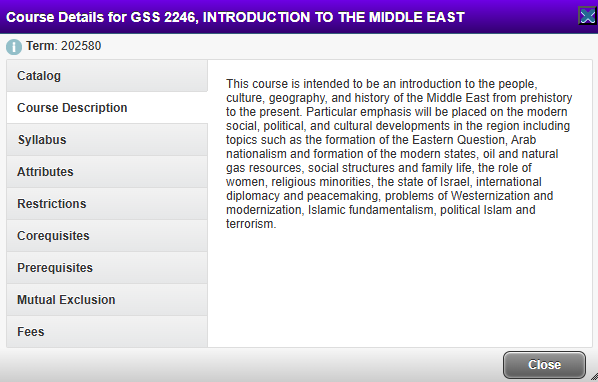
I received an A in the class, adding 16 “quality points” to my GPA, but I’ll admit I still don’t know much about the Ottoman Empire. My transcript reads Introduction to the Middle East. Classes appear on résumés, and employers might conceivably ask me about the Middle East.
The course catalog for Spring 2026 has an updated description:
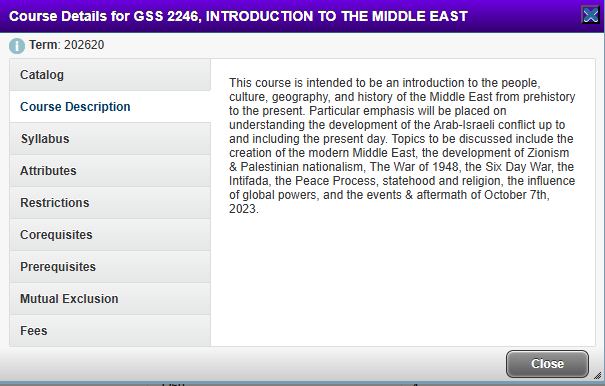
This new description matches what I learned in the fall semester: “Particular emphasis will be placed on the Arab-Israeli conflict…” — but why?
The simplified narrative presented in the course is that the Middle East exists primarily as the site of the Israeli-Palestinian conflict, rather than as the cradle of civilization. At our progressive university, the post-9/11 portrayal of the Middle East as a region defined by violent conflict remains pervasive. I am 30 years old and witnessed the first quarter of the 21st century unfold, but the average undergraduate in the class is 20, with little lived experience to understand why the world is the way it is.
College students should receive a wider perspective, not the pedagogically false narrative that people from the Middle East are inherently violent due to the rest of their history, including their art and scientific advances, not being shared with students of the course. If a group were inclined to cultivate Americans who viewed the Middle East as violent, they would certainly want courses to only encompass conflict. The reality we live in is aligns disturbingly well with that hypothetical scenario. Is that progressive?
Let’s examine Stockton’s official mission statement on inclusivity and diversity to see whether Stockton truly wants to advertise a progressive image. “We actively work to ensure equity and belonging. We embrace diverse identities, experiences, abilities, and perspectives. We confront prejudice and systemic inequities.”
The statement continues: “Through inclusive practices and an Ethic of Care, we enrich our University, strengthen our relationships, and prepare students to engage thoughtfully in a diverse, interconnected world.”
Words such as equity, diverse, prejudice and systemic inequities, inclusive will not be found on the mission statements of Brigham Young or Liberty University, two of America’s most conservative universities, or Fairmont State University, one of America’s least diverse universities. But you will find them in the mission statement of Stockton University — not advertised on a banner, but signaling the institution’s professional values.
To further this emphasis on diversity and equity, Stockton should hire a professor with a Ph.D. in a Middle Eastern field to teach a true introductory course on the region and, following the example of universities like Rowan and Rutgers, offer a separate class focused specifically on the Israel-Palestine conflict, rather than allowing it to dominate a regional survey.
I intend to make this a prominent issue, encourage hiring a professor to teach a real introductory on the Middle East, and a more hopeful idea, an entire Arab studies program. Stockton just needs to apply some of its executive power and institutional capacity to take concrete steps toward greater progress at our university.
Categories: Your Voice




 stocktonargo.com