
 Allie Agostino
 Iman Ahmed
 Christian Alvarez
 Brianna Barretta
 Kirah D. Cobbs
 Ryan Connelly
 Victoria Corless
 Mary DeRose
 Saira Desai
 Matthew Dietrich
 doogaho
 Dylan Kaminski
 Esmeralda Rivera
 Erin Nevin
 Anthony Bolton
 fourriea
 Jecce H
 jaredkeane
 Sarah Kropinack
 Laura Leonel
 Kayla Lavecchia
 liptack2gostocktonedu
 mary ceceilia
 Matt Cavallo
 Eli Mitros
 Elizabeth Myers
 Tyler Nicosia
 CHARLES OBIRINANWA
 Kollisa Pimentel
 Vincent Rapallo
 Shakila Riaz
 Tori Robbins
 Diamond Rogers
 Kamelea Saitova
 sarahcipkins
 The Argo
 suzannaccook
 Amanda Tague
 Jaedyn Thomson
 Danna Urias
 Breanna Vanaman
 Jennifer Vaneman
 victoriaorlow
 yoneluna
 Zuleika Rodriguez
Down in Miami, Florida, the Krome Detention Facility has been under fire for it’s cruel living conditions, such as lack of food and overcrowding (NPR). On November 23, a demonstration was organized by the Sunrise Movement to protest this poor treatment of immigrants and demand the closure of the facility.
What happened outside the Krome Detention Facility on November 23 began with a collective of youth organizers determined to bring a system of hidden violence into public view. They arrived knowing exactly where they stood: in opposition to a federal agency built to detain, silence, and disappear people.
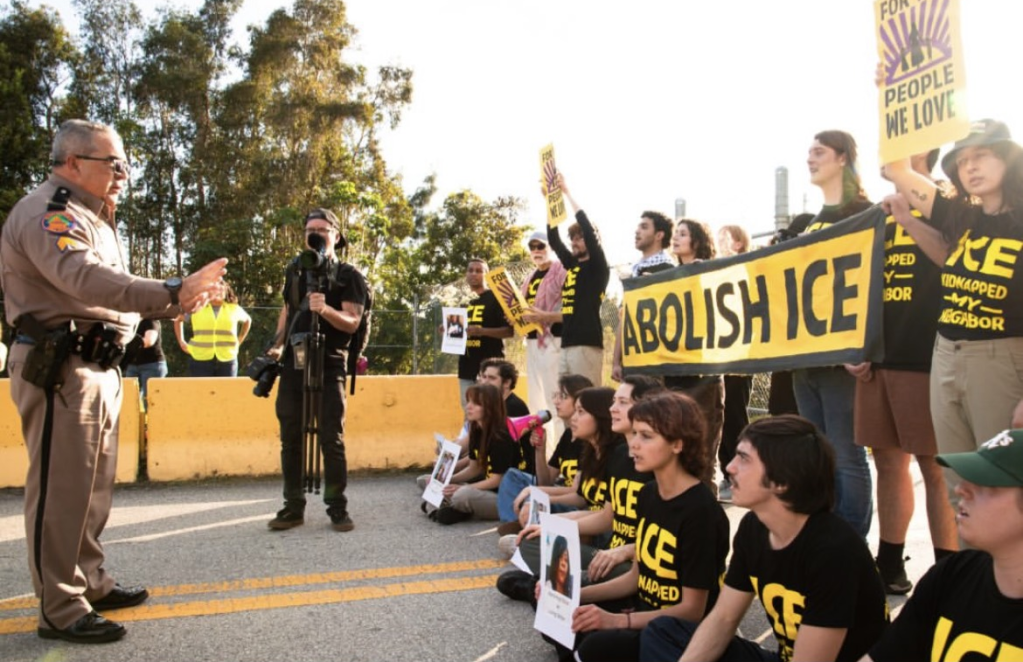
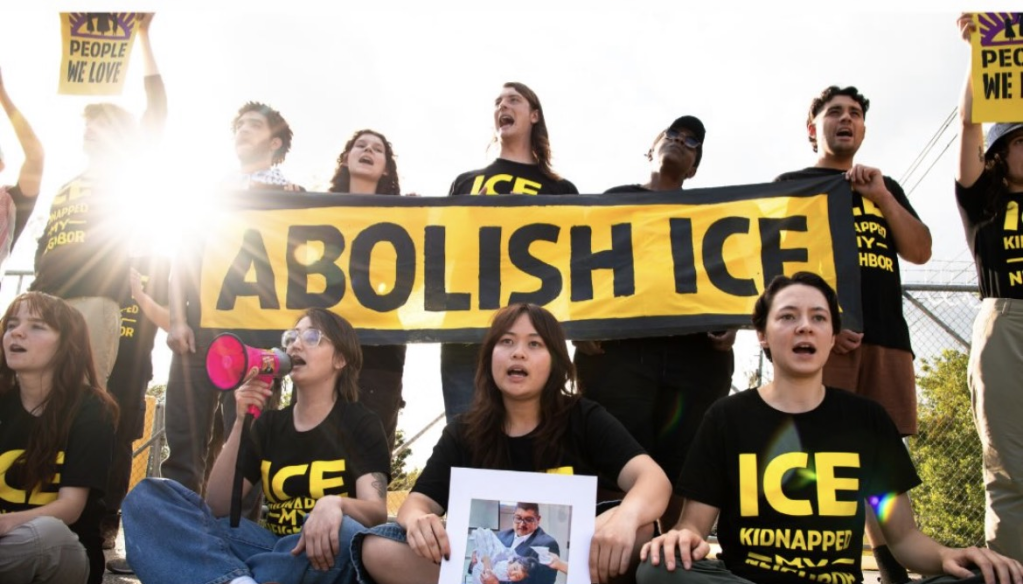
Protesters linked arms in a blockade, sang through tension, and braced themselves for what they already knew was coming. ICE had caught wind of the action long before anyone arrived; officers lingered around the perimeter, waiting, watching, calculating. Even in the moments that were outwardly calm, there was a pressure in the air—the kind that precedes a rupture.
For many of the protesters, the risk of arrest wasn’t a deterrent. It was an accepted cost of showing up for people who don’t get the chance to defend themselves. They weren’t there for symbolism. They were there to disrupt, to witness, and to force attention toward a system built to operate without scrutiny.
Among them was Eli, a Stockton student and Sunrise Movement organizer who had spent much of the year fighting for immigrant justice. He joined the blockade fully aware that he might end up in handcuffs, but was also aware that the stakes for him were nowhere near the stakes for the people inside Krome. As he put it, “Our experience in jail was not good…but it’s just crazy to think about how that’s only a very small fraction of what immigrants go through.” That realization, the contrast between risk and reality, is part of what keeps him involved.
At first, the protest held its shape. Organizers tried to keep spirits high by singing familiar liberation songs, even as police quietly coordinated in the background. Liaisons communicated professionally with officers. Protesters chanted and held their blockade, bracing themselves for the inevitable moment when law enforcement would decide they had heard enough. When that moment came, it came fast.
Without warning, officers escalated. They swept through the line of protesters with speed and precision, arresting them one by one. But they didn’t stop there. Journalists, photographers, and media observers were pulled in too. A credentialed national journalist had his ID inspected and was still taken into custody. It didn’t matter whether someone was participating or simply watching. Anyone with a camera posed a threat.
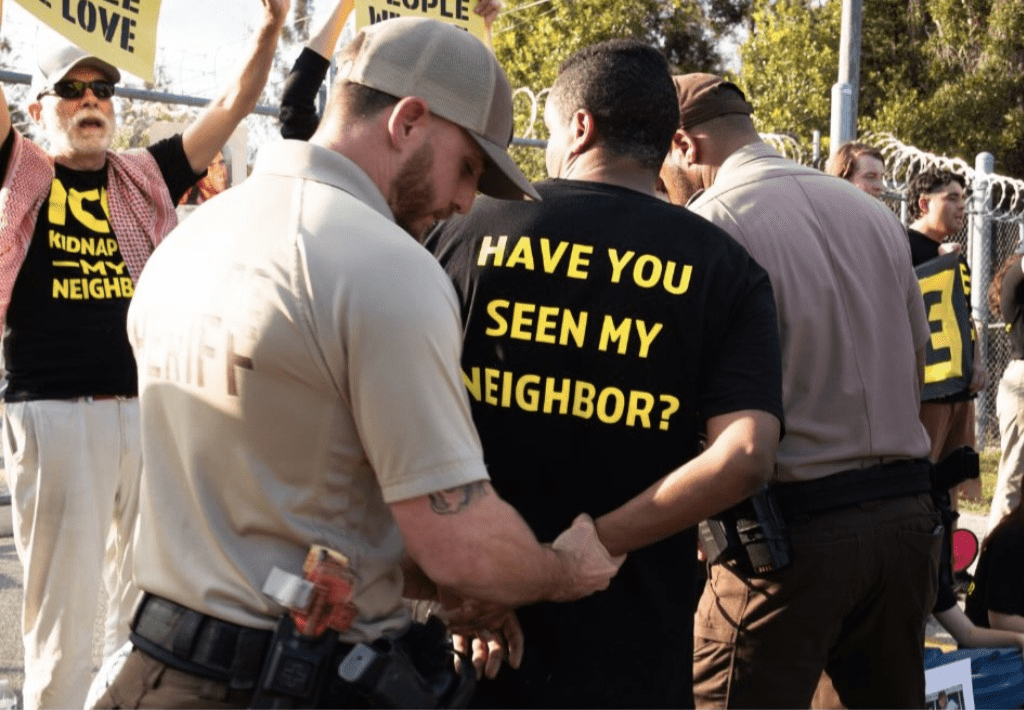
That became unmistakably clear once electronic equipment began disappearing. Cameras were confiscated. SD cards vanished. Video files were deleted. When equipment was returned, the footage had been wiped clean. “They took my friend’s camera,” Eli recounted. “He was taking a video of the inside of the police station…and when they gave his camera back, there was none of his footage.”
It wasn’t ambiguous or anecdotal; it was systemic erasure. Recordings of public officers performing public duties are protected under the First Amendment. The American Civil Liberties Union (ACLU) explicitly states that law enforcement cannot demand to review, seize, or delete recordings without a warrant. Deleting or destroying footage is not only unconstitutional—it can constitute evidence tampering, a criminal offense under federal and state law. What officers did that day wasn’t just suppression of the press; it was an unlawful attempt to control the narrative.
In the middle of the chaos, Eli held tightly to a photograph of a man, Chaofeng Ge, who died in ICE custody. For Eli, the image symbolized every person trapped inside a system that thrives on invisibility. Officers pulled down his arms, zip-tied his wrists, and dragged him away, but he refused to let go of the photograph. “I tried to hold my ground and I just focused on the man in the picture I was holding the whole time,” Eli said.
The next 24 hours unfolded with a kind of deliberate disorientation. Protesters were lined along the grass outside the detention center while officers processed them at an agonizingly slow pace. Florida flies swarmed their skin, biting relentlessly; the discomfort became a background noise to the humiliation. Some protesters had zip ties fastened so tightly that circulation became a genuine concern.
Inside the jail, people were divided, isolated, and treated with an arbitrary cruelty that mapped onto racial lines. People of color faced harsher treatment. One of Eli’s friends was denied access to essential heart medication. Eli himself was locked alone in a cell while others were allowed more mobility. “The randomness wasn’t random,” he said later. It was hierarchy. It was bias made operational. “It definitely made me more motivated to keep fighting for immigrants, seeing how terrible the conditions are even just outside the Krome detention center.” Eli fears how inadequate the conditions must be within.
By the time he was released at 2 p.m. the following day, nearly a full day had passed since his arrest. Others remained in custody even longer. The experience left Eli shaken not because of the physical discomfort, but because of what it revealed about ICE’s internal culture. Agents rolled up in pickup trucks, checked citizenship status on the spot, and made decisions that felt arbitrary, punitive, and unmoored from legitimate procedure.
The agents’ behavior in jail mirrored what Eli had witnessed elsewhere: a pattern of unchecked targeting that extended far beyond detention centers. At TSA, Eli was wearing a shirt that read “ICE kidnapped my neighbor,” which prompted him to be pulled into advanced security. The only other passengers singled out were non-white. To Eli, it made clear that this wasn’t an isolated injustice–it was a system, sprawling and quiet, embedded in daily life. He said, “It made me realize that immigrants are being targeted in day to day life too. It’s not just ICE, but also TSA, and so many others.”
For students at Stockton, Eli hopes his experience becomes more than a cautionary story. He sees it as a call to attention and agency. Support begins with relationships: looking out for immigrant friends and neighbors, learning the basics of their rights, knowing what a valid warrant must include, understanding what questions you can ask and how to intervene safely. It continues with knowledge: how to record police safely, how to document ICE encounters, how to share information without escalating risk. Silence doesn’t protect anyone. Awareness does.
Eli continues his work with the Sunrise Movement, where he hopes to start a Stockton-based hub. Sunrise is widely known for its climate activism, but the movement also acknowledges the intersectionality of justice issues; how climate, immigration, policing, and systemic inequality converge. It’s youth-led, accessible, and built around the belief that ordinary people can resist extraordinary harm. For Stockton students seeking a way to turn concern into action, Sunrise provides an entry point grounded in community, courage, and strategy.
What happened at Krome didn’t leave Eli intimidated: it left him galvanized. The arrests, the erasures, the uncertainty of the night—each part sharpened his understanding of what’s at stake. More than ever, he believes visibility matters. When cameras are wiped and stories are threatened with deletion, resistance depends on those who refuse to let go—not just of their footage, but of their clarity, their outrage, and their determination to protect the people whose lives are most at risk of erasure.
Categories: News and Events



 stocktonargo.com