
 Allie Agostino
 Iman Ahmed
 Christian Alvarez
 Brianna Barretta
 Kirah D. Cobbs
 Ryan Connelly
 Victoria Corless
 Mary DeRose
 Saira Desai
 Matthew Dietrich
 doogaho
 Dylan Kaminski
 Esmeralda Rivera
 Erin Nevin
 Anthony Bolton
 fourriea
 Jecce H
 jaredkeane
 Sarah Kropinack
 Laura Leonel
 Kayla Lavecchia
 liptack2gostocktonedu
 mary ceceilia
 Matt Cavallo
 Eli Mitros
 Elizabeth Myers
 Tyler Nicosia
 CHARLES OBIRINANWA
 Kollisa Pimentel
 Vincent Rapallo
 Shakila Riaz
 Tori Robbins
 Diamond Rogers
 Kamelea Saitova
 sarahcipkins
 The Argo
 suzannaccook
 Amanda Tague
 Jaedyn Thomson
 Danna Urias
 Breanna Vanaman
 Jennifer Vaneman
 victoriaorlow
 yoneluna
 Zuleika Rodriguez
David G. Brown is an artist, educator, publisher, and alumnus of the Stockton class of 1978. Brown has had great success in the world of political cartooning, and he sat down for an interview with The Argo to detail his journey from student to successful business professional.
The Early Days at Richard Stockton College
Starting with his childhood, Brown was never much involved in politics, expected to follow in his father’s footsteps and become a cook. However, he grew up surrounded by artists with his mother and brother. It was not until he arrived at The Richard Stockton College of New Jersey in 1973 that he would begin to delve into these sensitive subjects through his art. During his time at Stockton, Brown found ways to become immersed in the community, noting that the school’s population was not as diverse as it is today, hosting only a handful of black students. He joined a Black Fraternity, Iota Phi Theta, as well as the student newspaper known as The Argo.

Brown arrived at The Argo during its early stages, when the publication was just beginning to get established within Stockton. He was the first political cartoonist at the publication, but it did not begin that way. He started off by illustrating cartoons depicting student life, things like overcrowding in the dormitories and tuition being too high.
“I guess I’ve kind of always been a bit of a rebel, if you could say that. But not in a bad way, just wanting to give a voice to people and using my skill as an artist to be able to do that,” Brown said. He wanted to be able to represent students of all backgrounds by bringing “more cultural relevance to myself and the other students.”
The scarcity of fellow artists and African American peers is what led Brown to Iota Phi Theta: a historically African American fraternity, coming up on its 50th anniversary as an organization at Stockton.
Brown’s illustrations eventually got the attention of local business owners who were interested in hiring Brown to draw advertisements to be published in the paper as a way to appeal to the student audience. One of these businesses was the pub at Stockton, which operated on campus until 1997. They were interested in commissioning a drawing of students enjoying themselves at their business to promote their holiday events. Advertisements were and continue to be an important source of revenue for The Argo.
It was through this venture that Brown was able to get a job at a local advertising agency and he worked for the Yellow Pages while completing his degree. By the time he graduated, Brown had an entire portfolio of work he had created over his years in advertising and at The Argo, which served as a foundation for his success as an artist and educator.
“Without that launching pad,” said Brown, “I don’t know if my career trajectory would have been as successful as it was.”
Journey to the West Coast
Immediately after graduating, Brown was able to get a job in advertising at a printing and publishing company out of Cherry Hill, New Jersey. This opportunity led him to work for other agencies in Philadelphia before he made the decision to move out to the west coast, where he now resides in Los Angeles.
In Los Angeles, Brown worked as a Career Technical Education Teacher for a decade. In this position, he taught 12th graders design and animation. In his role as an educator, as someone who knew the industry, Brown felt it important to teach the students about the business side of creative fields.
“When you get into the industry it’s not about just having great art,” said Brown, “but also, how do you connect with people?” Students learned to pitch their ideas and navigate through the industry to find a niche they are passionate about.
He also taught cartooning at the California Institute of the Arts (CalArts).
The Los Angeles Sentinel
Brown has worked for the Los Angeles Sentinel as a political cartoonist since 2003. In this role, he recognized the importance of knowing his audience. “I live in Los Angeles and so my primary audience is African Americans in Los Angeles. So I do try to stay in sync with that audience, and so I try to stay relevant with the local politics.”
The liberal and diverse culture of the west coast is part of what prompted Brown to make the move. “I think it is important to be able to look at the world from the perspective of an African American, which I think oftentimes gets lost.”
“Until maybe the last two decades, who we are and our culture was defined by the dominating culture. So mostly, I mean the Western culture, European culture defined who African Americans were because they were the ones documenting it.” This further inspired Brown to begin writing a narrative from his perspective.
“That was the dominating narrative. And so, that’s one of the reasons why I think it’s really important that we tell our own stories and document our own culture.”
Tackling such polarizing political topics such as racism, police brutality, homophobia, gun violence, and global warming, among others, Brown is no stranger to receiving hate: “I still get a lot of hate mail and I get trolls on social media. I’ve even had conflicts with editors.”
Brown describes how he has had pieces receive pushback for their content criticizing certain politicians. “I feel like if someone is a politician serving the community, I think they need to be called out, no matter what color they are.” He feels it is important to keep everyone accountable, and that is what his work reflects.
As an artist, Brown understands the power that holding a platform holds, “I think if you look at history, artists have always been on the forefront of change.” He does not take this for granted, noting that it can even help shape culture. “I have a platform and I’m going to continue to use it for what I feel is, you know, a better society.”
Celebrating Success

Brown has clearly seen a lot of success throughout his career, so it is no surprise that he has also received prestigious awards for his works and built up a very distinguished clientele.
He has done work for companies like ABC-TV, Warner Brothers Motion Pictures, Wells Fargo, and the U.S. State Department among many others throughout his years in the industry.
In 2009, he was the recipient of the NAACP Image Award for his book “Barack, Race and the Media: Drawing my own Conclusions.” He has earned several Merit Awards for “Best Editorial Cartoon” from the National Newspapers Publishers Association and was featured in the Pelican Publishing Company Inc.’s “Best Editorial Cartoons of the Year” from 2005 through 2014.
He currently has an exhibit being hosted at the Watts Towers Arts Center in Los Angeles titled Politics, Race and Cartoons, which is up through February 2026.
Publishing
Along with his work in the L.A. Sentinel, Brown has long had an interest in comic books and graphic novels. He has produced and published multiple serieses.
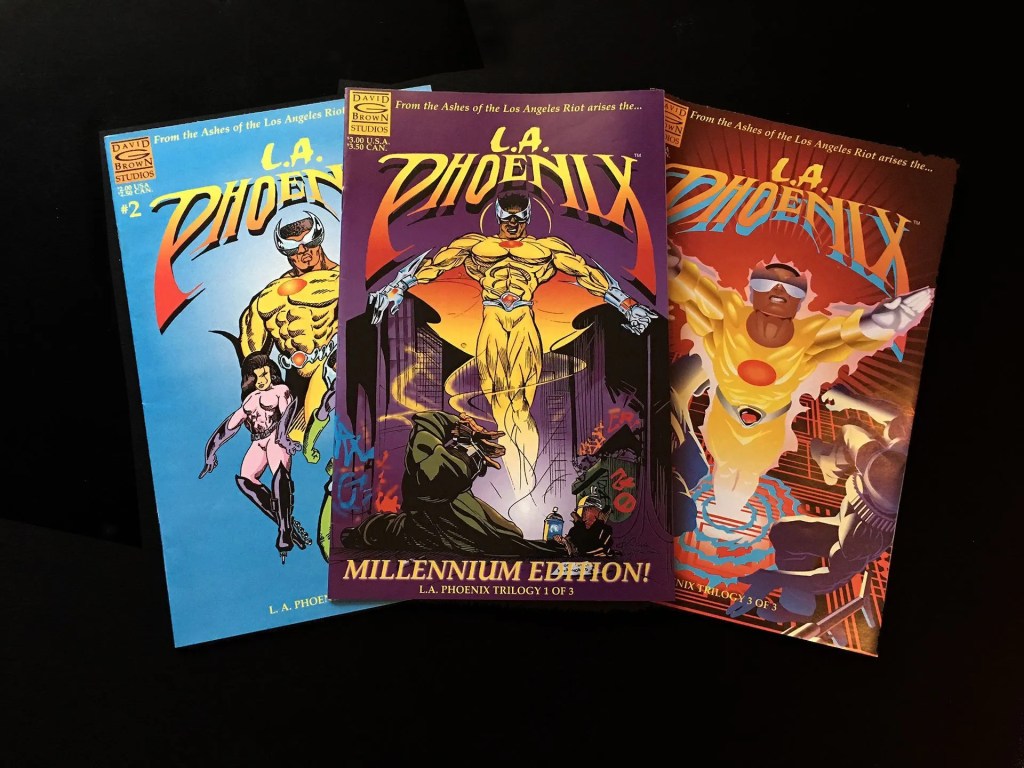
“The L.A. Phoenix” is a fictional super hero trilogy, the idea coming about after the 1992 Los Angeles riots. The titular character is a black superhero who helps heal the city following the tragic violence and death. He was a figure that rose from the ashes and promoted a message of healing. Additionally, Brown has produced a series for children titled “Tales From the Kids,” as well as authoring two books, one about the COVID pandemic and another being his award winning novel on President Barack Obama.
“The L.A. Phoenix” gave Brown the opportunity to speak at schools, libraries, and community centers. “That led to me wanting to do stuff with young people […] Why not give the kids a voice?” From this, he began writing his series “Tales From the Kids,” as well as hosting workshops teaching kids from 7 to 17 basic drawing skills and how to create stories.
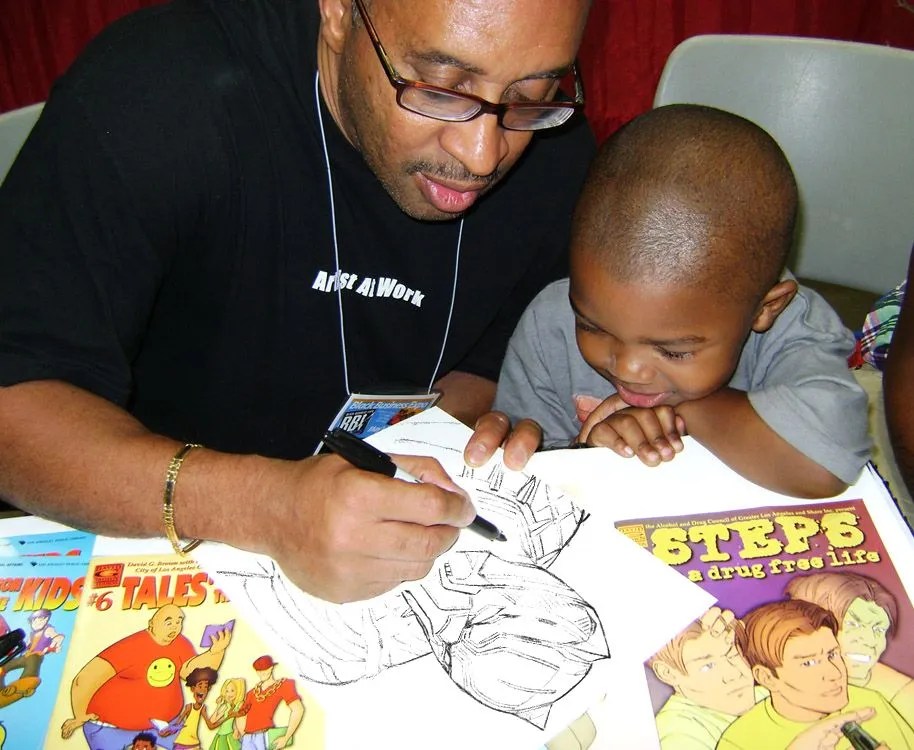
“I guide them through understanding, ‘How do you solve conflict without violence?’ […] ‘How do you have healthy lifestyles, read, you know, embrace other cultures, eating right, exercise, staying away from drugs’ […] they can actually get the chance to illustrate these stories. It’s become a very powerful way for kids to understand some basic values.” Brown distributes his series “Tales from the Kids” to all 65 branches of the Los Angeles library system for the summer reading program.
“To me, that’s my greatest legacy. That gift to those students that are going on and being able to do something with their skills in a positive way.”
Brown has been able to build a great career from his hard work and dedication to his beliefs. “I just felt that it was important to have a voice and have a place, and I still feel that way with what I do now, because even as a political cartoonist, there are very few African Americans.”
Today, Brown continues to be involved in the Stockton community, serving as Vice Chair of the School of Arts and Humanities Dean’s Advisory board and as a student mentor.
For more information or to view David G. Brown’s work, visit his website at http://www.davidgbrownstudio.co
Categories: Campus Life



 stocktonargo.com