
 Allie Agostino
 Iman Ahmed
 Christian Alvarez
 Brianna Barretta
 Kirah D. Cobbs
 Ryan Connelly
 Victoria Corless
 Mary DeRose
 Saira Desai
 Matthew Dietrich
 doogaho
 Dylan Kaminski
 Esmeralda Rivera
 Erin Nevin
 Anthony Bolton
 fourriea
 Jecce H
 jaredkeane
 Sarah Kropinack
 Laura Leonel
 Kayla Lavecchia
 liptack2gostocktonedu
 mary ceceilia
 Matt Cavallo
 Eli Mitros
 Elizabeth Myers
 Tyler Nicosia
 CHARLES OBIRINANWA
 Kollisa Pimentel
 Vincent Rapallo
 Shakila Riaz
 Tori Robbins
 Diamond Rogers
 Kamelea Saitova
 sarahcipkins
 The Argo
 suzannaccook
 Amanda Tague
 Jaedyn Thomson
 Danna Urias
 Breanna Vanaman
 Jennifer Vaneman
 victoriaorlow
 yoneluna
 Zuleika Rodriguez
Written for The Argo by Jeanmarie Gomolka
On Wednesday, September 10, Stockton Counseling & Psychological Services (CAPS) shared an instagram post for National Suicide Prevention Day. The post included fact checks on the myths revolving around speaking about suicide, along with the following caption: “This month, we come together to raise awareness, break the stigma, and remind ourselves and those around us that you are not alone. Reaching out for help is NOT a sign of weakness, but instead a sign of strength. Please know that support is always within reach. Keep the conversation going!”
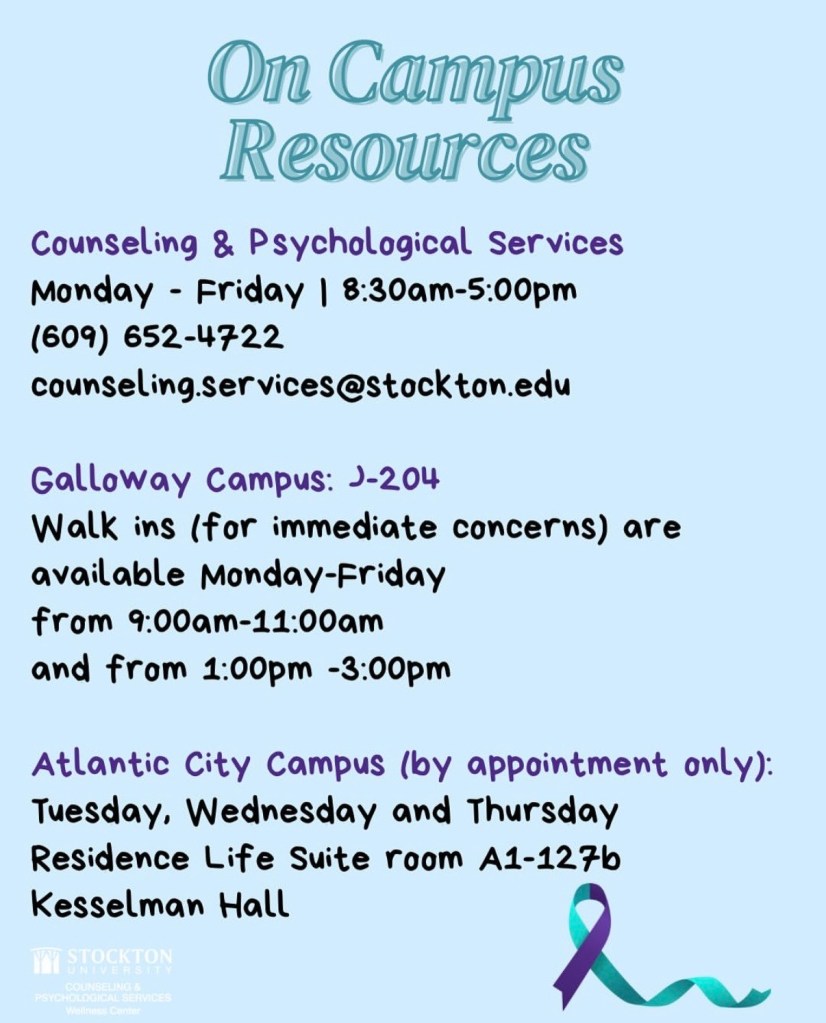
As September is Suicide Prevention Awareness Month, Mental Health Peer Mentors will offer tabling events to spread awareness on mental health and educate about the resources available on and off campus. This includes mental health services and support groups, in addition to providing information on local outside resources.
During the Fall 2025 semester, Mental Health Peer Mentors will table on campus monthly. Each month, they will have a new theme and cause to support and spread awareness about. At the tables, peer mentors will be handing out flyers, free items, and resource information to help Stockton Ospreys stay on top of their mental health wellness.
Nathan Morell, a Mental Health Counselor at the Stockton Wellness Center, presented the following questions he hopes students will ask themselves: “What if things could be better?”; “Are you willing to be a little uncomfortable in the short run, in the hopes of being healthy in the long run?”
Morell states, “If you want things to be different, you have to do different things.” He then mentioned how the stigma of mental health breaks when people start conversations about it.
The CAPS program wishes to showcase the resources that are easily accessible and free for students to use. They are presenting the availability of safe spaces for anyone who might be struggling with their mental health, as well as providing connections to resources available outside the walls of Stockton University.
The Argo reporter, Jeanmarie Gomolka, sat down with Morell to discuss how to identify if someone is in a crisis and needs help.
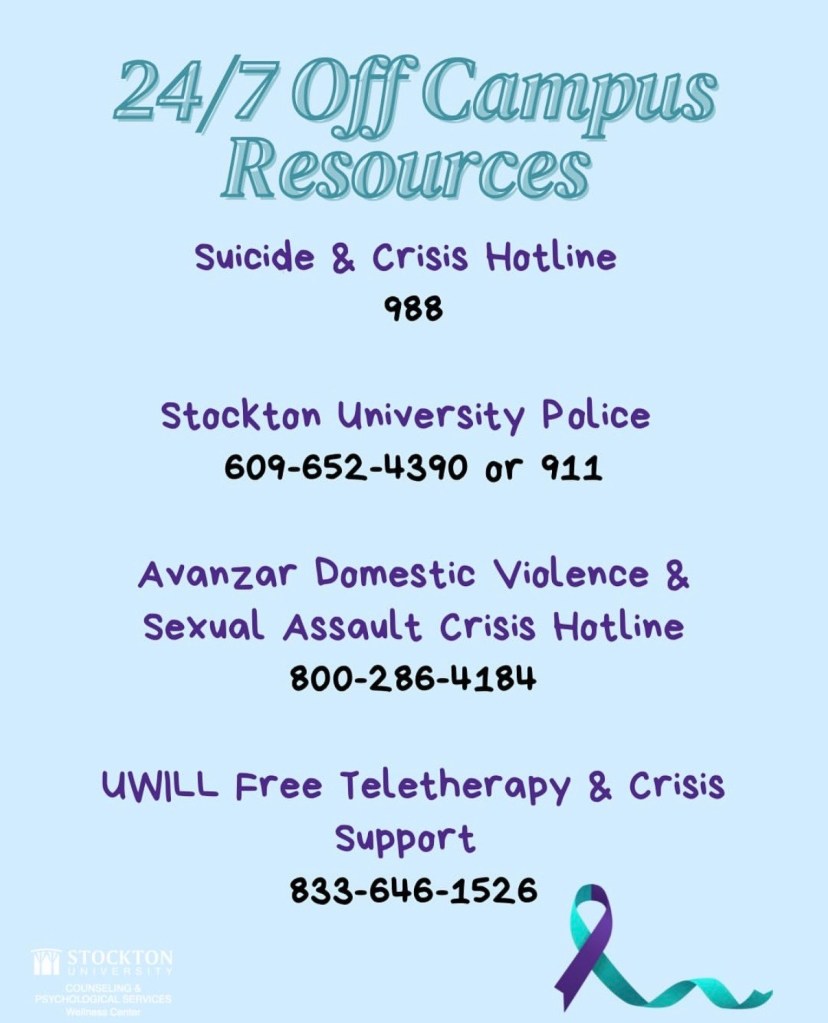
A list of off-campus mental health resources. Graphic courtesy of @Stocktonucaps Instagram.
Gomolka: How do you identify if someone is in crisis? What are the signs and symptoms to look for?
Morell: There’s just normal being depressed, being anxious, that’s part of being human beings. That’s not necessarily a pathology, but if it’s something that affects one of your abilities to function—you can’t have friendships, you can’t go to school, you can’t go to work—that’s where it crosses over from the normal stuff to more of a clinical kind of thing. Or if someone mentions thoughts about dying or death or not wanting to be here, those are red flags. If they are drinking more, using more drugs, kind of any change. It could also be a change where someone is depressed for a year and then all of a sudden they are happy, maybe they are happy because they decided they’re going to die from suicide. There isn’t always signs, I would just say talk to the people who are in your life or in your circle. Check in with people: “Hey, how are you feeling, no like really, how are you feeling? How’s life?” Just letting people know that you’re a person, and you’re okay to talk about these kinds of things. People don’t always open up right away but letting them know you’re here and you care when they are ready to talk, then they’re more likely to come to that person and show that.
Gomolka: How can you bring up the topic?
Morell: You can go direct or indirect. You can say, “Hey, are you in crisis right now?” or “Hey, I’ve noticed I haven’t seen you around lately” or “You’ve seemed down a lot lately.” Not judgmental stuff, just mentioning these are things that you’ve noticed so that you’re opening that door to a conversation. Talk to them privately in a safe environment.
Gomolka: What language should you use? Is there language that might trigger someone?
Morell: Any judgmental language I would avoid. Just show up and say something, that’s way more important than when some people get scared and they don’t want to say the wrong thing. If you ask someone about suicide and they’re not suicidal, you’re not going to make them become suicidal. A lot of people are afraid of that. But if they are, that could be a great opportunity to talk about what’s going on inside. You can say, “When you said this, I was concerned, what did you mean by that?” or “What’s going on, what’s happening, I’m here, I want to listen.” The words themselves aren’t as important as the fact that you’re showing up and that you care. I would focus more on that.
Gomolka: What resources can you provide them?
Morell: If someone tells you that they are going to kill themselves, I would call the police because they can send help directly to them. There’s also UWill, there’s a crisis line that’s free for everybody, and you can do weekly counseling with them. Stockton’s Counseling Center has walk-ins from 9-11 a.m. and 1-3 p.m. every weekday. Call or text 988 crisis line. The cool thing with that is that there are a lot of options here that you don’t need insurance for. You don’t need a copayment, and it’s confidential. If it’s urgent, there’s a hospital right on campus if it’s an actively suicidal case.
Gomolka: Where do you find such resources?
Morell: You can go to the CAPS Stockton page online and we have all of our information and what we do on there, but it also has UWill and the crisis number and how to schedule right on the page.
Gomolka: Can you schedule an appointment with UWill right from the Stockton CAPS page?
Morell: Yes, you just have to use your Stockton email and you get connected right from there. And it is free: it is paid for through a grant from New Jersey, which is great. Say someone can’t get here from 9-5, they have other things where they can work with you. And If you’re worried about someone else you can also do a CARES referral through Stockton. Doing the CARES report puts that person on the attention of the helpers for the school. You can even do it anonymously.
Gomolka: If a person needs help themselves, what can they do?
Morell: I would dial 988, call the UWill crisis number, use the Counseling Center walk-ins, those would probably be the first things that I would do. There is also a mental health urgent care in Atlantic City for those who live on the AC campus. It’s called AIS, the Adult Intervention Crisis Services on North Hartford Avenue.
“A big thing about mental health is just talking about it and just changing the conversation about mental health. That small change early on can lead to a totally different path,” concluded Morell.
On Monday, September 22, there will be a peer mentor tabling from 11-12 outside of the Dunkin’ Donuts. Be sure to follow @stocktonucaps on Instagram for more posts on mental health and look out for their future tabling events. Visit them in J-204 on the Galloway campus.
Categories: Campus Life



 stocktonargo.com