
 Allie Agostino
 Iman Ahmed
 Christian Alvarez
 Brianna Barretta
 Kirah D. Cobbs
 Ryan Connelly
 Victoria Corless
 Mary DeRose
 Saira Desai
 Matthew Dietrich
 doogaho
 Dylan Kaminski
 Esmeralda Rivera
 Erin Nevin
 Anthony Bolton
 fourriea
 Jecce H
 jaredkeane
 Sarah Kropinack
 Laura Leonel
 Kayla Lavecchia
 liptack2gostocktonedu
 mary ceceilia
 Matt Cavallo
 Eli Mitros
 Elizabeth Myers
 Tyler Nicosia
 CHARLES OBIRINANWA
 Kollisa Pimentel
 Vincent Rapallo
 Shakila Riaz
 Tori Robbins
 Diamond Rogers
 Kamelea Saitova
 sarahcipkins
 The Argo
 suzannaccook
 Amanda Tague
 Jaedyn Thomson
 Danna Urias
 Breanna Vanaman
 Jennifer Vaneman
 victoriaorlow
 yoneluna
 Zuleika Rodriguez
Stockton is one of the more affordable colleges in South Jersey, and in the fall of 2023, had nearly 9,000 students enrolled. On average, 1 in 4 people in the US are disabled; this means that on average, nearly 2,500 students who attend Stockton University are likely to be disabled.
Stockton’s mission statement says, “Stockton University is committed to building a community that values differences of race, religion, gender, ethnicity, national origin, socio-economic status, affectional or sexual orientation, gender identity or expression, marital status, age, ability, or disability. We accept our responsibility to create and preserve an environment that is free from prejudice and discrimination and to take actions that affirm our commitment to inclusivity and diversity.”
Likewise, Stockton’s Policy for Disability, Accessibility, and Reasonable Accommodations I-67 states, “Stockton University values diversity and seeks to promote access to employment and educational opportunities. As such, it is committed to full compliance with Section 504 of the Rehabilitation Act of 1973, 29 U.S.C. § 701 et seq. (“Section 504”), and the Americans with Disabilities Act of 1990, 42 U.S.C. §§ 1201-12213 as amended (“ADA”), and provides reasonable accommodations to qualified employees and students with disabilities to allow for full participation in the University’s employment and educational programs and activities.”
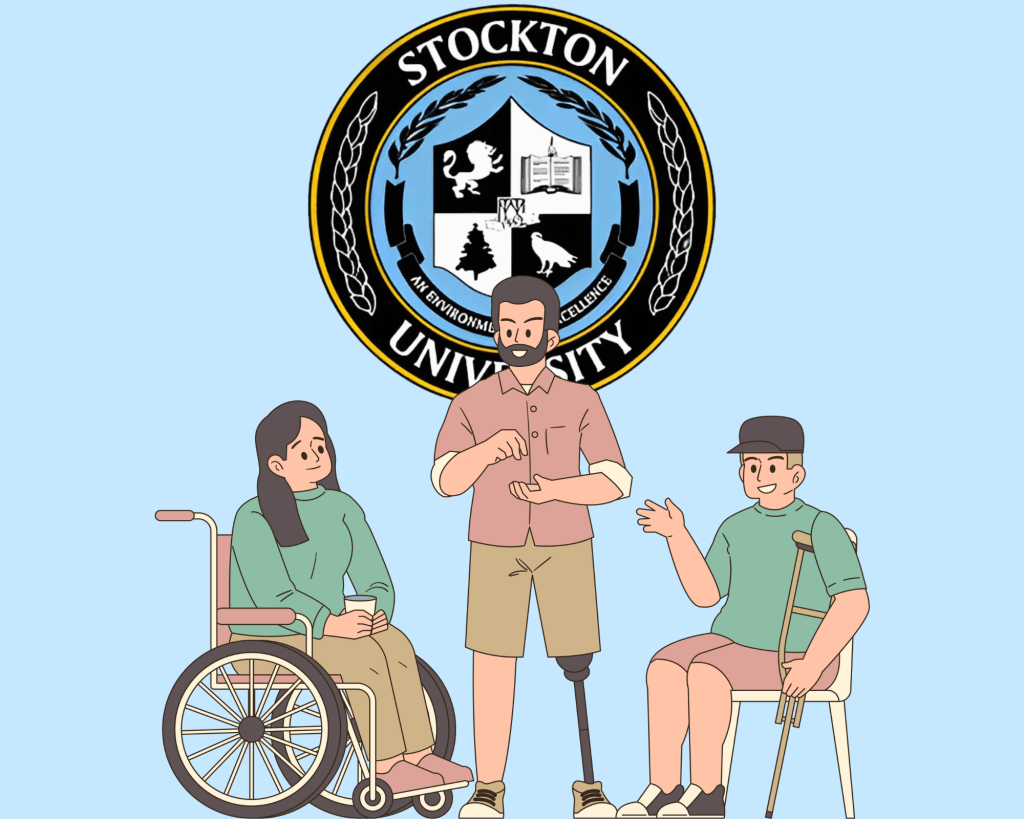
Though these statements can be seen as true in some situations, many disabled students on campus struggle. I, myself, struggle on campus as an ambulatory wheelchair user; ambulatory wheelchair users are people who can walk but use wheelchairs for some, if not all, mobility needs. I am in a wheelchair most days of the week, and when I am not, I use a cane to walk. I am very open about my disability, and in being so, I wish to bring the issues to the attention of all students and staff at Stockton.
On March 3, I attempted to go through the Arts & Sciences building to wait for the Atlantic City Shuttle for the John F. Scarpa Academic Building. I was unable to enter the building due to a difference in the height of the ground and the threshold of the automatic double-doors. I ended up going around the building and waiting outside in 30-degree and windy weather, and then when the shuttle finally arrived, they had no wheelchair lift, causing me to entirely miss my class and the valuable information within it. This issue has since been resolved, but this should have never been an issue to begin with.
Many of Stockton’s automatic doors end up broken and not fixed, or, even when they are working, they are incredibly slow, delayed, or do not open all the way. With the ground being uneven and cracked, it is dangerous for me in a wheelchair; if I hit a hole the wrong way, I could get stuck or knocked over.
When asked about Stockton’s accessibility in regards to on-campus activities, one student, who wished to remain anonymous, stated, “I’m a freshman, so especially during Welcome Week, when I was supposed to be having fun and connecting with other students, I was not able to. A lot of the activities outside of mandatory lectures and presentations were physical activities such as athletic games that I cannot participate in. There were about two total events that entire week, I can recall, that I was able to go to. I know not everyone is disabled, and some people can and do enjoy doing those things, but there were not enough options for people like me to also do alongside that.”
Other students wish to see more education on disabilities. Ricky Collucci, when asked “What advice would you give Stockton to create a more inclusive environment for disabled students?” responded, “Educational events, seminars or guest speakers. Or just asking disabled people about their experiences and incorporating that into future decisions.”
Zippi Abramson, a Stockton University Student Senator, rated Stockton’s overall accessibility a 7 out of 10 and when asked to explain, she stated, “I personally believe that there’s compliance with the ADA versus somewhere actually being truly accessible for students with physical disabilities. While they’re [Stockton University] ADA compliant and are fairly good otherwise, I still think they could improve with better accommodations, better things such as more/better doors, more reliable elevators, wheelchair accessible shuttles, etcetera.”
Stockton University has the chance to lead in accessibility, but currently, too many students with disabilities are being overlooked. No student should have to face difficulties merely to access a building, participate in class, or feel like a part of campus life.
True transformation begins with awareness, but it needs to be accompanied by action. The administration, faculty, and students of Stockton each contribute to ensuring the campus is genuinely accessible. The university has previously made commitments — now it’s time to carry them out.
Students with disabilities deserve more. The inquiry is…will Stockton pay attention?
Categories: Your Voice



 stocktonargo.com