
 Allie Agostino
 Iman Ahmed
 Christian Alvarez
 Brianna Barretta
 Kirah D. Cobbs
 Ryan Connelly
 Victoria Corless
 Mary DeRose
 Saira Desai
 Matthew Dietrich
 doogaho
 Dylan Kaminski
 Esmeralda Rivera
 Erin Nevin
 Anthony Bolton
 fourriea
 Jecce H
 jaredkeane
 Sarah Kropinack
 Laura Leonel
 Kayla Lavecchia
 liptack2gostocktonedu
 mary ceceilia
 Matt Cavallo
 Eli Mitros
 Elizabeth Myers
 Tyler Nicosia
 CHARLES OBIRINANWA
 Kollisa Pimentel
 Vincent Rapallo
 Shakila Riaz
 Tori Robbins
 Diamond Rogers
 Kamelea Saitova
 sarahcipkins
 The Argo
 suzannaccook
 Amanda Tague
 Jaedyn Thomson
 Danna Urias
 Breanna Vanaman
 Jennifer Vaneman
 victoriaorlow
 yoneluna
 Zuleika Rodriguez
As the United States grapples with political division and efforts to suppress its history, Stockton University takes an unwavering stand in fostering inclusivity and unity. The annual Pan-African flag-raising ceremony, hosted by the Unified Black Students Society (UBSS), was not merely a tradition but a powerful declaration: Black history is not up for debate—it is woven into the very fabric of this nation.
A Symbol of Strength, Resistance, and Legacy
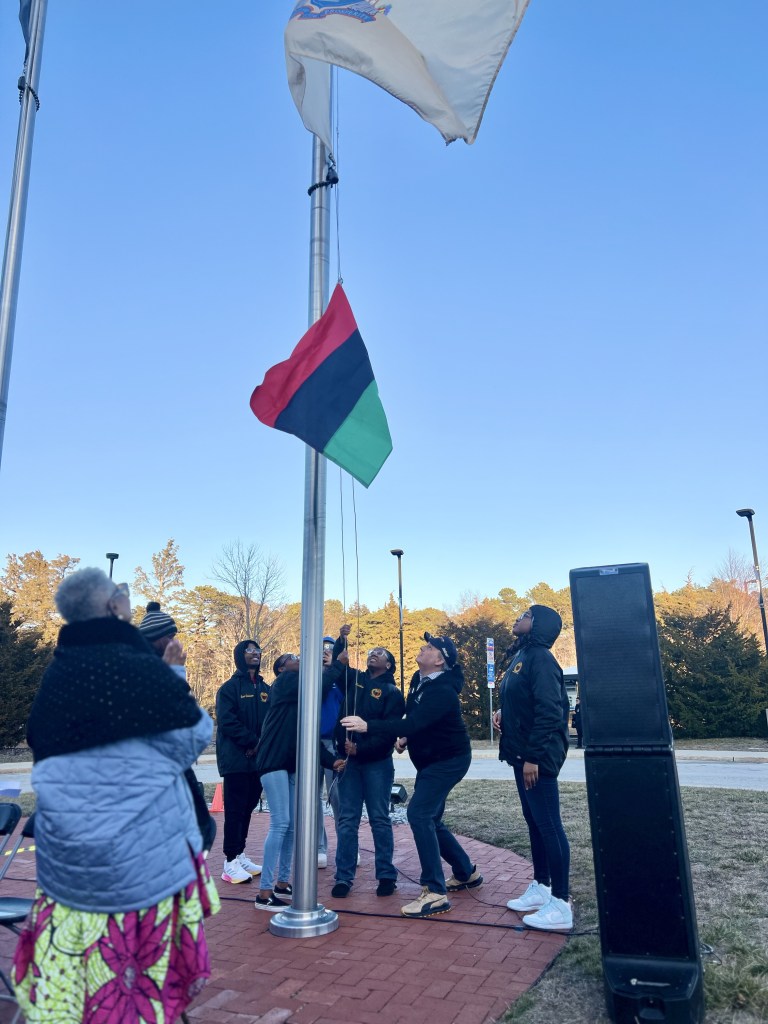
The Pan-African flag, composed of red, black, and green, has long symbolized the unity and resilience of the African diaspora. Originating from Marcus Garvey’s Universal Negro Improvement Association (UNIA) in 1920, it remains a global emblem of Black liberation and pride.
Opening the ceremony, Elizabeth Macklin, President of UBSS, emphasized the profound significance of this event: “We come together today to raise the Pan-African flag, a symbol of unity, pride, and resilience. This flag represents the struggles and triumphs of our brothers and sisters across the world. However, this flag is much more. It is a call to action. It reminds us that while we celebrate the achievements of the past, we must continue to work towards justice and progress.”
She further stressed the urgent need for solidarity in today’s socio-political climate: “It is especially clear how important it is to be unified and recognize that our strength lies in education, commemoration, and community.”
Defying Erasure: A Declaration of Black History’s Permanence
My’Air Henry, Vice President of UBSS, echoed these sentiments, addressing the contemporary challenges Black history faces with the words, “Now, we know that beyond this space, there are efforts to silence or erase Black history. So let’s be clear: our history is not up for debate. It is woven into the very fabric of this nation, and no policy can erase it.”*
These words resonated deeply with the audience as they reflected on the growing attempts to restrict discussions on systemic racism and historical injustices in educational institutions across the country.
Introducing the keynote speaker, Dr. William Latham, Interim Vice President for Student Affairs, Henry concluded, “Today, as we raise this flag, we affirm that Black history is not just something we acknowledge in February. It is something we live, honor, and carry forward every single day.”
Dr. William Latham: A Commitment to Inclusivity
Dr. Latham, a Morehouse College graduate and longtime advocate for student development, took the stage with a message of reflection and action. Representing the Stockton senior leadership team, he reaffirmed the university’s dedication to diversity and inclusion: “Stockton’s campus culture is about recognizing inclusivity and embracing each other during these very special, unique opportunities to celebrate. Today, celebrating Black history is important, it’s needed, and it’s crucial—especially in this political climate.”
Encouraging students to engage beyond the month of February, he urged that, “We invite all of us to understand and celebrate our cultures better and deeper during this month and this season. We welcome conversations that enlighten all of us on how we can be more inclusive of all races and cultures at Stockton University.”
The Meaning of the Pan-African Flag
Among the speakers was Guivenchiali St. Jean, Secretary of the Stockton Chapter of the NAACP and a Peer Educator at the Multicultural Center. Engaging the crowd, he asked how many attendees knew the meaning behind the Pan-African flag before elaborating on its significance.
St. Jean said, “The red represents the blood of our ancestors that was shed in the fight for freedom and liberation in the face of oppression. The black represents Black people everywhere and is a reminder to take unwavering pride in our identity. The green represents the land of Africa, the past, present, and future of a continent still reclaiming its autonomy after centuries of exploitation.”
St. Jean also paid homage to the NAACP’s historic role in fighting for civil rights: “The NAACP has been active since 1906, advocating for the empowerment and civil rights of African Americans. From Brown v. Board of Education to the Civil Rights Act of 1964, and today, as we continue addressing racial disparities in healthcare, housing, and education, we remain committed to justice.”
Black History: A Legacy of Triumph and Innovation

The event continued with an address from Lynnsey Raphael, founder of the Caribbean Students Association (CSA), who reminded the audience that Black history is world history: “It is the foundation of science, art, literature, and civil rights movements that have shaped societies across the globe—from the shores of Africa to the streets of Selma. Black history is not just about the struggle; it’s about triumph.”
Raphael honored historical trailblazers, stating, “It’s about Harriet Tubman leading hundreds to freedom, Martin Luther King Jr. dreaming of a just world, and Shirley Chisholm breaking barriers in government. This flag waves high today as a declaration that we are seen, valued, and powerful.”
Embracing Global Blackness: A Message from the African Student Organization
Representing the African Student Organization, Chiamaka Patrick challenged the notion of Blackness as a monolithic experience. “Too often,” Patrick said, “being African is seen as separate from being Black, but the truth is Blackness is a vast and beautiful identity that spans continents, histories, and cultures. Whether our roots are in Africa, the Caribbean, or right here in America, we are all connected.”
Encouraging unity, she declared, “Let this flag not just be a symbol, but a reminder of our strength and limitless power. Let’s show up for one another, support Black organizations, and engage in conversations that push us forward.”
Student Reflections: A Call to Action
The ceremony concluded with the singing of “Lift Every Voice and Sing,” also known as the Black National Anthem. Following the event, students shared their reflections in interviews.
Aaron, a Stockton student, described the event as “inspiring and empowering,” adding, “It makes me want to get more involved in my community.”
Andrew Lynch, an Irish-American student, expressed his appreciation: “I feel a lot more called to action about multiculturalism. It was really meaningful.”
Anisa Grullon shared, “With everything happening in the world, this reminds me that we still have each other. Even if we’re not acknowledged the way we should be, we acknowledge and love each other.”
Looking Forward: Continuing the Legacy
Stockton University’s commitment to inclusivity extends beyond Black History Month, with events such as the Black Joy and Excellence Panel, historical lectures, and artistic showcases. As the Pan-African flag soared against the February sky, the message was clear: Black history is not confined to February—it is a legacy that lives, breathes, and thrives every day.
Categories: Your Voice




 stocktonargo.com