
 Allie Agostino
 Iman Ahmed
 Christian Alvarez
 Brianna Barretta
 Kirah D. Cobbs
 Ryan Connelly
 Victoria Corless
 Mary DeRose
 Saira Desai
 Matthew Dietrich
 doogaho
 Dylan Kaminski
 Esmeralda Rivera
 Erin Nevin
 Anthony Bolton
 fourriea
 Jecce H
 jaredkeane
 Sarah Kropinack
 Laura Leonel
 Kayla Lavecchia
 liptack2gostocktonedu
 mary ceceilia
 Matt Cavallo
 Eli Mitros
 Elizabeth Myers
 Tyler Nicosia
 CHARLES OBIRINANWA
 Kollisa Pimentel
 Vincent Rapallo
 Shakila Riaz
 Tori Robbins
 Diamond Rogers
 Kamelea Saitova
 sarahcipkins
 The Argo
 suzannaccook
 Amanda Tague
 Jaedyn Thomson
 Danna Urias
 Breanna Vanaman
 Jennifer Vaneman
 victoriaorlow
 yoneluna
 Zuleika Rodriguez
As Hispanic Heritage Month comes to a close, Student Development gave students an opportunity to share their stories and personal experiences with their peers at the monthly Story Space, hosted in the Multicultural Center. Parth Thakkar hosted the event and provided chips and dip as a tasty snack for the guests. Guests who attended were descendants from many different Latin American countries, including Mexico, Guatemala, Dominican Republic, and El Salvador, among others. Free prizes such as water bottles, notebooks, blankets, and soup bowls were given to the students that participated.
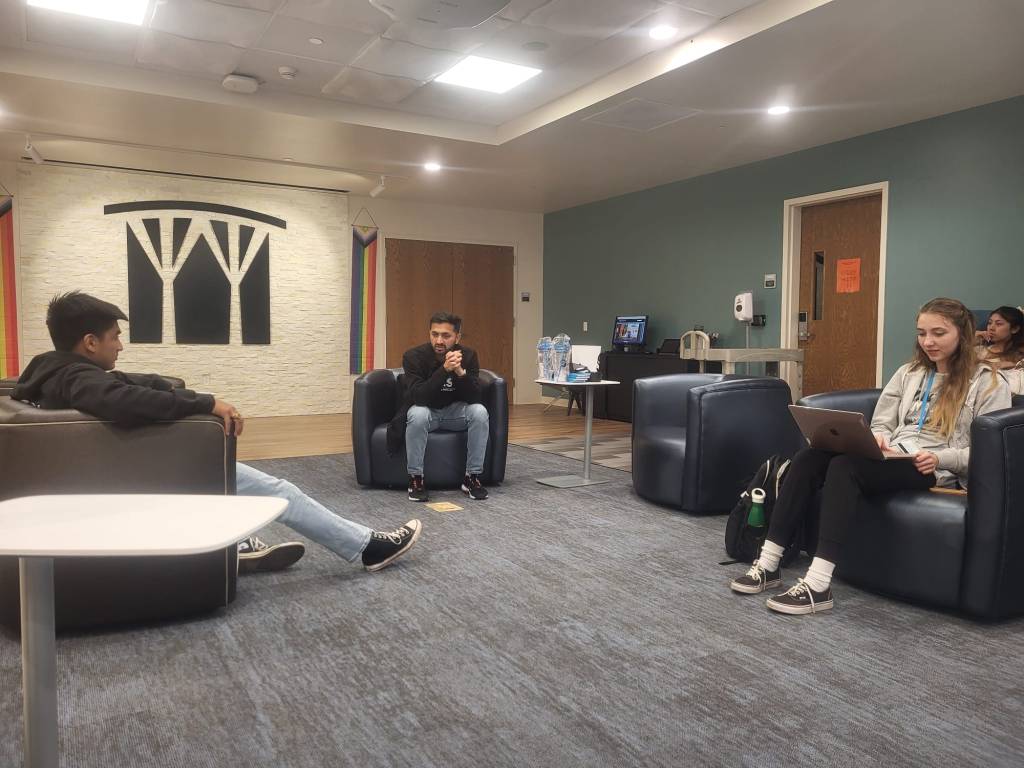
Parth himself shared the story of how, when he moved from India to the United States, he met other students of Hispanic descent for the first time, since it’s not common to find Hispanic people in India. Khrystyna Svystovych, a Ukrainian international student and a regular attendee of Story Spaces, expressed the same, admiring the diversity of the United States, particularly the student body at Stockton.
One student, Natalie, who is Guatemalan, talked about how she moved to Guatemala at a young age, which caused her to forget what she knew in English. Once she returned to the United States and started school, she felt overwhelmed and disoriented, having to relearn the language after only speaking Spanish for so long, especially since there were no Spanish speakers in her school. The group also laughed and joked about different dialects in different Latin American countries, which tends to be very confusing for those learning Spanish as a second language. Most schools teach European Spanish, which differs greatly from Latin American Spanish, much like how English in the United Kingdom differs from English in the United States. The group compared phrases and slangs such as “Speak of the Devil” being translated into “Hablando del rey de Roma,” or Speak of the King of Rome, which many found odd since it is not a direct translation at all.
One Mexican-American student told the other attendees about how he cannot choose between his American and Mexican halves. “I’m not Mexican; I’m not American. I’m Mexican-American,” he expressed. He talked about his fighting career in MMA, where he always wears a Mexican-American flag and has a Spanish song that blasts out of the speakers with pride when he does his entrance. He joked, “The announcers always say, ‘Oh, it’s this kid with the flag.'”
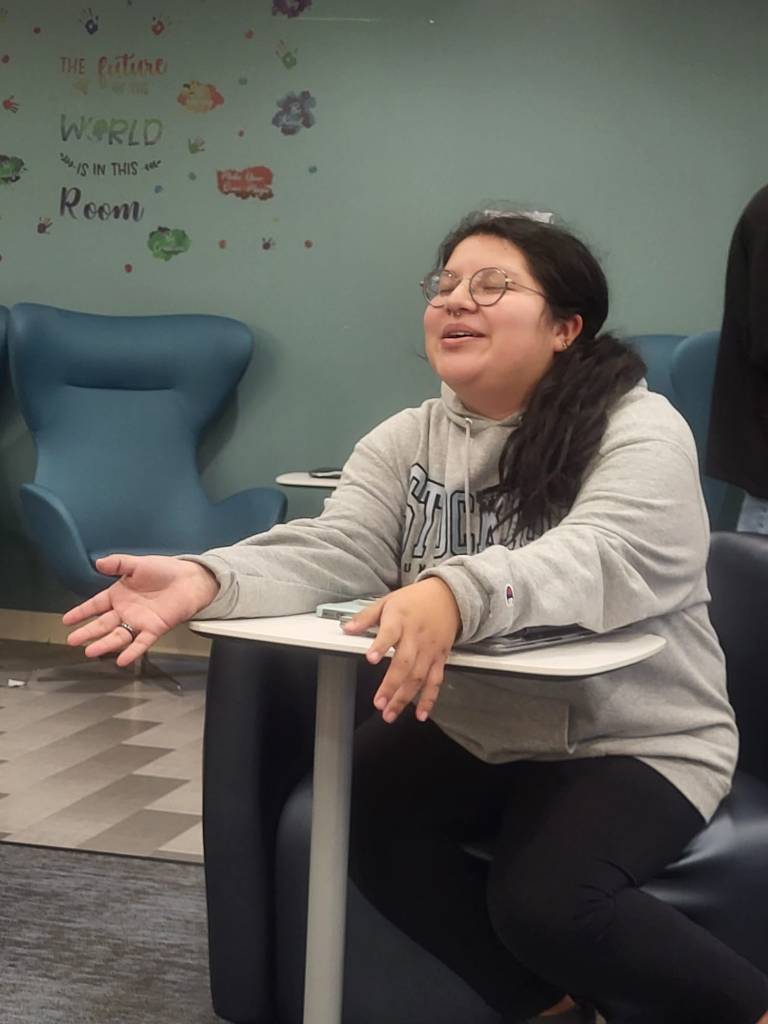
Andrea Sandoval, President of Student Senate, related to his story since she is also a Mexican-American who found herself “stuck in the middle.” “When I was younger, I was lighter-skinned, so people assumed I was white,” she told the guests, “then I would speak Spanish, and they’d know I was Hispanic.”
The conversation evolved into a healthy, open discussion on racism and colorism in the Latin American world. One of the Mexican-American students added to the conversation spoke about his stepfather, who is white, and how Hispanic people in his area of Central Jersey treat his stepfather differently from him and the rest of his family. “We noticed that they would always bring his plate last; we’d be halfway through our meal and my dad’s plate would finally come. They always get his order wrong and the rest of us get it right. It’s just something we came to notice,” he said. A Dominican student talked about how people with darker skin tones are often discriminated in the Dominican Republic, since these individuals are assumed to be Haitian. The Dominican Republic has had a lot of political and social tension with Haiti for years, since Haiti colonized the Dominican Republic in the early nineteenth century.
Esmeralda Rivera, President of the Guatemalan Student Association, also spoke about her own experience living in Guatemala. Her father was a light-skinned Puerto Rican and people would assume he was white. Esmeralda and her mother noticed how people treated both of them differently. Many would be more polite towards her father than her mother, since her mother is darker-skinned. “Whenever we went out shopping, we would avoid speaking English, since vendors would double or even triple the prices as soon as they heard us speaking like ‘gringos,'” she said.
Khrystyna Svystovych spoke about how she experienced discrimination based on her family’s socioeconomic class more than her skin color. She told the group about how she and her family had to work in the fields in Poland when she was an adolescent. She said, “They would treat [us] poorly, even though we’re the same skin color.” Esmeralda also related to socioeconomic division in Guatemala, since she studied in a school that had predominantly “upper-class” students in her early years, and later went to a school with predominantly low-income students, which made it hard for her to fit in either world, circling back to the theme of being “stuck in the middle.” The conversation led to the students expressing that discrimination sadly seems to be inherent in every culture and community, and that skin color and socioeconomic class are all too often used as a tool to judge a person’s character and worth.
The next Story Space will be on November 13th at 4:30 in the Multicultural Center with the theme “I Am Thankful For…”. Be sure to attend, as there will be stories to tell, free merchandise, and refreshments.
Categories: Campus Life



 stocktonargo.com