
 Allie Agostino
 Iman Ahmed
 Christian Alvarez
 Brianna Barretta
 Kirah D. Cobbs
 Ryan Connelly
 Victoria Corless
 Mary DeRose
 Saira Desai
 Matthew Dietrich
 doogaho
 Dylan Kaminski
 Esmeralda Rivera
 Erin Nevin
 Anthony Bolton
 fourriea
 Jecce H
 jaredkeane
 Sarah Kropinack
 Laura Leonel
 Kayla Lavecchia
 liptack2gostocktonedu
 mary ceceilia
 Matt Cavallo
 Eli Mitros
 Elizabeth Myers
 Tyler Nicosia
 CHARLES OBIRINANWA
 Kollisa Pimentel
 Vincent Rapallo
 Shakila Riaz
 Tori Robbins
 Diamond Rogers
 Kamelea Saitova
 sarahcipkins
 The Argo
 suzannaccook
 Amanda Tague
 Jaedyn Thomson
 Danna Urias
 Breanna Vanaman
 Jennifer Vaneman
 victoriaorlow
 yoneluna
 Zuleika Rodriguez
Deciding whether to pursue graduate school can be a daunting choice. It is a big decision, as it demands significant investment financially and personally. In the current job market, Master’s degrees seem to be the new Bachelor’s degree, leading to the frequently asked question — is graduate school the next step, or is it unnecessary to obtain ones desired career goals?
On October 6, 2024, Stockton University held an Open House for future and prospective undergraduate and graduate students, offering the opportunity to learn about Graduate school — if it is the next step in their career journey — and whether Stockton’s grad school is the right fit. During the events, faculty, staff, and student leaders offered presentations, provided information, and answered questions about navigating the early stages of this process.

Is Grad School the Next Step?
In conversation with Jennifer Radwanski, Associate Director of Graduate Admissions at Stockton University, about deciding whether graduate school is the right choice, she advised: “[…] it has to be a good gut feeling number one, but with that graduate school is expensive and it’s a lot of time and energy. However, if you pick a program or an area that you really love and are passionate about, it’s worth every penny and worth every minute because you enjoy what you are doing.”
There are a number of reasons that lead someone to pursue graduate school. There are some who wish to further their education, pursue a personal passion, seek growth, and in many cases advance career development. In the latter situation, if a student is unsure whether graduate school is appropriate, the first step is personal introspection and research to become familiar with the chosen career path. While Google is a great resource for this information, consulting with Stockton’s faculty, staff, and the Career Education and Development Center offers valuable insight.
In addition, students can partake in internships and conduct informational interviews with professionals who hold the career position they are interested in pursing to learn more and create a plan to reach the end goal. For example, if the aspiration is to become a practicing counselor, the minimum degree requirement is a Master’s degree. Thus, pursuing a Master’s or even Doctoral degree is an essential step in this career plan. With other careers that typically have a less clear route, an advanced degree may not be necessary. However, it could still help a candidate stand out in a job pool and further career standing. Ultimately, the decision to pursue graduate school is a personal choice based on several factors.
Selecting Potential Schools and Programs
Once a student decides graduate school is the right choice, the next step is to create a pool of schools and programs that match personal, academic, and lifestyle needs. There are a number of details to consider that differ from person-to-person when looking at schools. Some key deciding factors include financial, location, modality (in-person, hybrid, online synchronous online asynchronous), meeting times, program length, accreditation, curriculum, specializations, professional opportunities, faculty, community, and the culture. It is helpful to create a table with these factors and establish what programs match the student’s needs. With this table, research the schools, browse their websites, and contact their graduate admission’s teams with any questions. Eliminate the schools and programs that do not meet non-negotiable criteria.
Narrowing the Choices: What Schools and Programs Fit
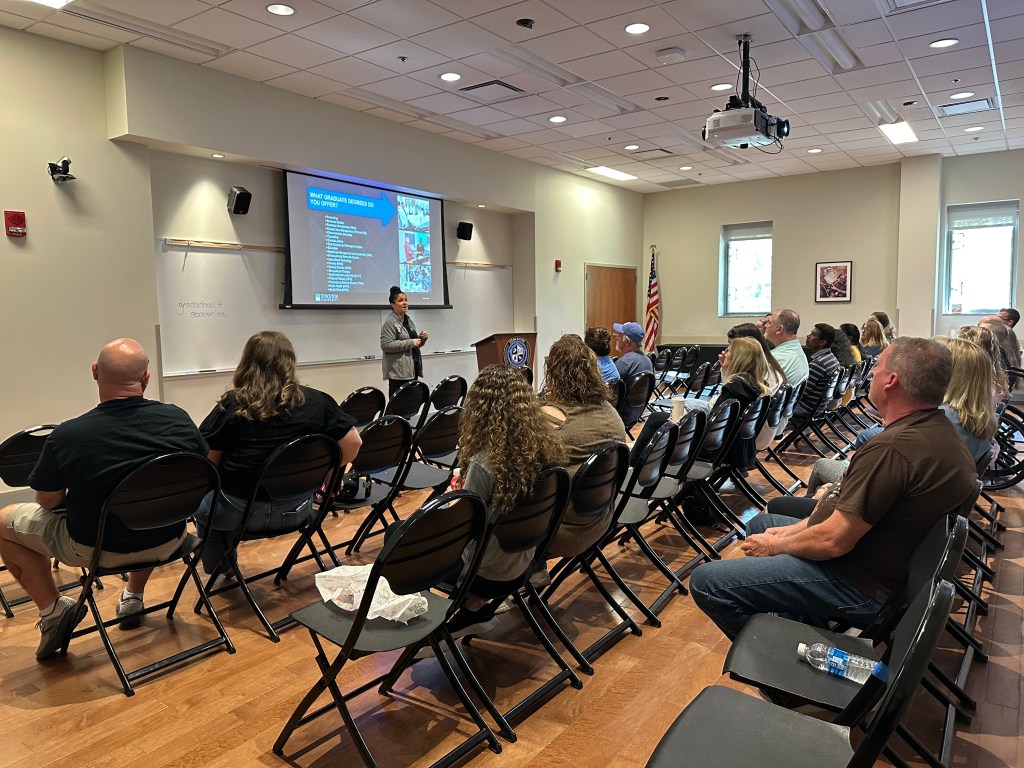
Armed with a list of suitable schools that meet basic needs, it is time to start thinking about which schools are the best fit. This will provide clarity during applications and decisions. Radwanski offered recommendations for finding this clarity: “[…] you have to find that program where you have that good gut reaction. Where you walk in, either if it’s an in-person program, you walk on campus and your like ‘oh, I enjoy being here.’ If it’s an online program, the modality, you go ‘yeah, this fits with what I need to do,’ and so it has to be the combination of all those things. You know, looking at the program and making sure it’s a good fit for what you want to be learning and what you want to be doing for your career, and then having it be a good fit with the institution, and those things I think are really key, and similar to what people looked at in undergrad.”
Alexa Raparelli, a Stockton alum and current staff member in the Graduate Admissions office, shared “I chose Stockton because it felt like home. I felt a sense of community and family the minute I stepped on campus. Stockton also provided me with the best opportunities; educational, professional, and social. Stockton built the doors that ultimately led me to be the woman I am today!”
To help determine if a school is the right fit, attend open houses (virtual or in-person) and speak with the faculty of your potential program. This allows students to become familiar with the applications, curriculum, faculty, school culture and community. A few upcoming events at Stockton are open houses dedicated to specific Masters Programs, which offer information tailored to these programs. These include for Social Work on October 8th, Counseling on October 17th, Criminal Justice on October 23rd, Communication Sciences and Disorders on October 24th, and Instructional Technology on October 30th. More information and registration is available on Stockton’s Graduate Admissions page under events.
Categories: Campus Life




 stocktonargo.com