
 Allie Agostino
 Iman Ahmed
 Christian Alvarez
 Brianna Barretta
 Kirah D. Cobbs
 Ryan Connelly
 Victoria Corless
 Mary DeRose
 Saira Desai
 Matthew Dietrich
 doogaho
 Dylan Kaminski
 Esmeralda Rivera
 Erin Nevin
 Anthony Bolton
 fourriea
 Jecce H
 jaredkeane
 Sarah Kropinack
 Laura Leonel
 Kayla Lavecchia
 liptack2gostocktonedu
 mary ceceilia
 Matt Cavallo
 Eli Mitros
 Elizabeth Myers
 Tyler Nicosia
 CHARLES OBIRINANWA
 Kollisa Pimentel
 Vincent Rapallo
 Shakila Riaz
 Tori Robbins
 Diamond Rogers
 Kamelea Saitova
 sarahcipkins
 The Argo
 suzannaccook
 Amanda Tague
 Jaedyn Thomson
 Danna Urias
 Breanna Vanaman
 Jennifer Vaneman
 victoriaorlow
 yoneluna
 Zuleika Rodriguez
As Black History Month progresses, Stockton has held many events to celebrate the important month. On February 19, the nine historically black fraternities and sororities from the National Pan-Hellenic Council (NPHC), also known as the Divine Nine (D9), presented themselves at the Multicultural Center for a panel discussion on their history. Six D9 members, some being faculty members and some being Stockton alumni, lent their time to be panelists. Kayla Flowers and Courtney Combs, both members of the Multicultural Center’s P.R.E.P. Team, hosted the panel.
The panel comprised of Dr. Adrian Wiggins, Director of Campus Public Safety, from Phi Beta Sigma Fraternity Inc.; Dr. Zupenda Davis, Assistant Vice President for Student Health and Wellness, from Sigma Gamma Rho Sorority Inc.; Dr. Terricita Sass, Executive Vice President of Stockton University and Chief of Staff, from Alpha Kappa Alpha Sorority Inc.; Dr. Chris Catching, Assistant Vice President for Student Health and Wellness, from Iota Phi Theta Fraternity Inc.; Dr. Alexis Jenkins, Director of GOALS Gear Up, and recently initiated member of Zeta Phi Beta Sorority Inc.; and Summer Hill Seven, Graduate Coordinator of Programming and Adjunct Faculty member, from Alpha Phi Alpha Fraternity Inc., the same fraternity that Martin Luther King Jr. was a part of.
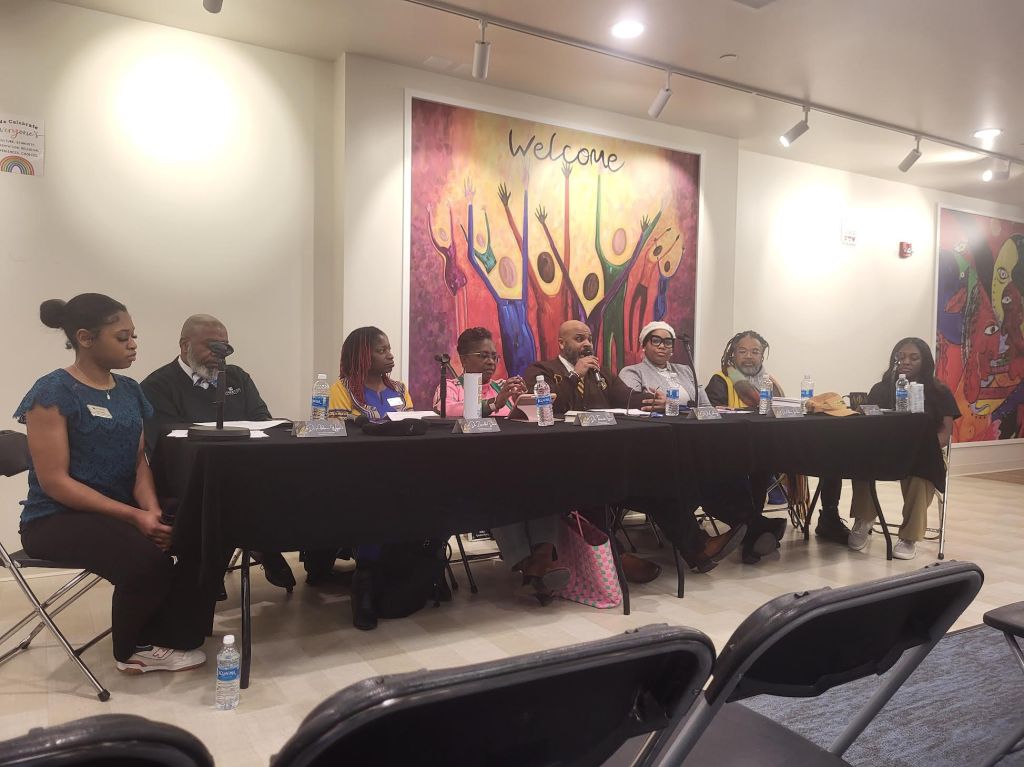
The panelists talked about each of their chapters, their values, and their experiences. All of them have received meaningful experiences, memories, and lessons through their brotherhoods and sisterhoods. They wore their letters and colors proudly and spoke with a great amount of respect and admiration for their organizations, reminding attendees that a fraternity and/or sorority membership doesn’t simply end in college, but continues for life, which applies to every Greek organization in existence. “When you go forward in the organization, the membership provides you with support throughout your lifetime,” Dr. Wiggins expressed. “I don’t say I was a member of Phi Beta Sigma Fraternity Inc., I am a member of Phi Beta Sigma, and I carry that throughout my life and my community.” Dr. Sass added, “We all have pledged our hearts to be knitted together wherever we are. So, I know that wherever I move in all 50 states, and around the country, in 55 countries, that I have Sorors (sorority sisters) that I can connect with that just welcome you for being you.” Her sorority, Alpha Kappa Alpha, has chapters in the United States, the Caribbean, Canada, and South Africa, and is the first Black sorority, founded in 1908 at Howard University.
They also talked about how they came to meet those in their organizations and what led them to join. Most joined in their undergraduate years in college, while some others, like Dr. Jenkins, got to know alum chapters in graduate school through friends and colleagues. Their organizations also provided amazing networking opportunities; Dr. Sass recounted how she found out her former boss, now mentor, was in her organization, and provided her with a strong friendship and resources for her career. Seven remarked, “I believe that your organization chooses you.” He had not met any members of Alpha Phi Alpha, since there was no chapter on his campus, but was referred to the organization by a friend, who told Seven about many notable alumni of the fraternity, including Dr. King. “I got men like that, that I could roll with for the rest of my life, learn with,” Seven recounted. “It was really about the calling, the service, the duty, the mission of the organization.” Alpha Phi Alpha was the first Black Greek fraternity, founded in 1906 at Cornell University.
Jenkins recounted how her mentor, who is a member of Zeta Phi Beta, coached her through her Praxis exam to become a Math teacher, which she had failed twice. While she was involved on campus in her undergrad years, she didn’t join a Greek organization until after graduation. “I had the leadership in me, I just needed more development,” Jenkins said. Her mentor “wrote out a whole plan” for her and taught her many skills in leadership, which helped her receive her doctorate. When Jenkins contacted her mentor and told her of her plans to join Zeta Phi Beta, they reacted with extreme enthusiasm and drove 7 hours from Buffalo to surprise Jenkins at her initiation ceremony and give her the sorority pin. “That’s real sisterhood,” Jenkins remarked. She also told attendees of the time her grandfather passed away and how her sorority sisters supported her by visiting her at her home, bringing food, and offering emotional support. “When life really starts happening, that’s when you will see who will show up for you,” she said.
Categories: News and Events, Stockton News




 stocktonargo.com