
 Allie Agostino
 Iman Ahmed
 Christian Alvarez
 Brianna Barretta
 Kirah D. Cobbs
 Ryan Connelly
 Victoria Corless
 Mary DeRose
 Saira Desai
 Matthew Dietrich
 doogaho
 Dylan Kaminski
 Esmeralda Rivera
 Erin Nevin
 Anthony Bolton
 fourriea
 Jecce H
 jaredkeane
 Sarah Kropinack
 Laura Leonel
 Kayla Lavecchia
 liptack2gostocktonedu
 mary ceceilia
 Matt Cavallo
 Eli Mitros
 Elizabeth Myers
 Tyler Nicosia
 CHARLES OBIRINANWA
 Kollisa Pimentel
 Vincent Rapallo
 Shakila Riaz
 Tori Robbins
 Diamond Rogers
 sarahcipkins
 The Argo
 suzannaccook
 Amanda Tague
 Jaedyn Thomson
 Danna Urias
 Breanna Vanaman
 Jennifer Vaneman
 victoriaorlow
 yoneluna
 Zuleika Rodriguez
From November 15 to November 26, 2023, Stockton University’s “Model U.N. Study Tour” class flew to Germany to represent varying nations in the National Model U.N. Conference in Erfurt, Germany.
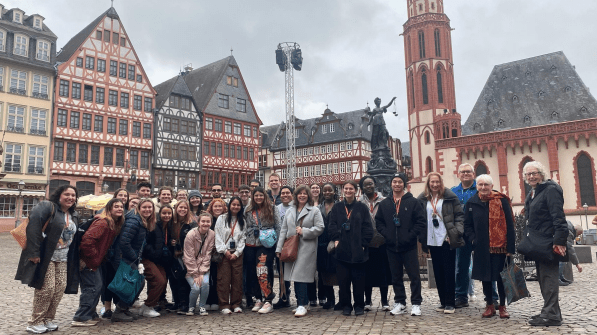
The group of students arrived in Frankfurt on the morning of November 16; led by Dr. Micheal Hayse and Dr. Tina Zappile, the class spent the first half of the trip on a cultural tour. This was centered around remembering the Holocaust. One of the key memorials was the Stolpersteine or “stumbling stones.” These are small memorials on the pavement and are placed all around Germany. They are specifically in locations of the last known residence of victims of the Holocaust. Since many of these victims don’t have gravesites, it is a way to remember them and their history.
The group then moved on to Buchenwald, which was a U.S.-liberated concentration camp. In the camp, students saw first-hand the conditions that the victims were under so many years ago. The group also visited Point Alpha, which formerly divided East and West Germany. They heard first-hand accounts from those who knew what it was like to live in a divided nation.
On November 19th, 2023, the group left Frankfurt and arrived in Erfurt, Germany, where the National Model United Nations conference would soon be held. The opening ceremony of the conference featured a guest speaker, Maud Dahme. She traveled with the Stockton group throughout the trip. Maud is a Holocaust survivor who resides in New Jersey and has a published book about her story: Chocolate, the Taste of Freedom.
In her speech, Maud detailed her experiences growing up in the Holocaust. She recounted, “First of all, it’s a pleasure to be back in Germany, and thank you so much for the invitation for me to speak to you all today. 70 years ago, when I was in high school, I was a part of a junior UNESCO club. But it’s a pleasure for me to be here and to share a very quick overview of what happened to my family during the Second World War. We lived in the Netherlands. My grandparents came to the Netherlands because they thought they would be safe, but obviously, it was not as safe as people thought it would be. But I was just a little girl.”
“One of the funny stories that I can remember is in 1942, anyone who was six years old and older had to wear the yellow star [of David]. I was so excited! Because I’m now a grown-up. My sister was only four and couldn’t. I don’t remember too much until the day that we had to go into hiding.”
“We were very fortunate. The resistance in the Netherlands was great and an address was found without my parents, for my sister and I. Christian families were willing to take us in and risk their lives because if we were found, then they too would be taken. My sister was four and a half, I was six and a half. I was told we were going to a farm, on a vacation. The day we arrived on the farm, they sat me down and told me why I was there. We stayed with the family, I couldn’t go to school and at first, I was given a new name. I was told I had to remember it at that age because we were supposed to be their nieces who had been bombed out of the city.”
“At first, we had to stay in the house and not go near the windows or answer the door. Then, we helped them on the farm every day. They were wonderful people. My parents had no place to go. Friends asked them to stay with them. We left everything and my parents stayed in their friends’ attic for three years. My parents survived also, because their friends saved them. We went into hiding in the summer of 1942. It was right after Christmas in 1944, they thought we were discovered and we quickly had to move to another family. We were freed by Canadians, [as] most of the Netherlands was. It was during the winter of hunger in the Netherlands. So the soldiers that arrived threw out their rations of chocolate, but I didn’t know what it was. Chocolate was my first taste of freedom,” she said.
“There had been no contact with my parents. I didn’t know them when they finally came and I didn’t recognize them. The adjustment afterwards was difficult, to suddenly be reunited with your parents who you did not remember. At first, I had no desire to even go home with them. I’m now nine and a half years old and it was so difficult coming back after the war and having nothing and discovering most of our family was not coming back and were murdered. I’m alive today thanks to people who cared so much. My message to students is that to care for each other, [it] shouldn’t matter where you come from or what you look like. Inside we’re all the same…have respect.”
When asked about her experience with politics, her response was “I’ve held political office and when I was asked a question about something, I answered it honestly. Just the way I felt. My husband used to say you’ll never win… I won. I wish for politicians to focus on the average person instead of their next election.”
The NMUN Committee sessions began and would continue for the next three days. Stockton represented Spain, Sweden, Ghana, Morocco, and Romania in the General Assembly, Human Rights Council, Security Council, and UNEA. The conference was attended by students from universities all over the world. The experience of traveling to a foreign country, visiting cultural sites, Holocaust sites, hearing from Maud, and participating in a conference with countless international students was truly a life-changing experience for all the students involved.
Categories: Stockton News



 stocktonargo.com