
 Allie Agostino
 Iman Ahmed
 Christian Alvarez
 Brianna Barretta
 Kirah D. Cobbs
 Ryan Connelly
 Victoria Corless
 Mary DeRose
 Saira Desai
 Matthew Dietrich
 doogaho
 Dylan Kaminski
 Esmeralda Rivera
 Erin Nevin
 Anthony Bolton
 fourriea
 Jecce Harriott
 jaredkeane
 Sarah Kropinack
 Laura Leonel
 Kayla Lavecchia
 liptack2gostocktonedu
 mary ceceilia
 Matt Cavallo
 Eli Mitros
 Elizabeth Myers
 Tyler Nicosia
 CHARLES OBIRINANWA
 Kollisa Pimentel
 Vincent Rapallo
 Shakila Riaz
 Tori Robbins
 Diamond Rogers
 Kamelea Saitova
 sarahcipkins
 The Argo
 suzannaccook
 Amanda Tague
 Jaedyn Thomson
 Danna Urias
 Breanna Vanaman
 Jennifer Vaneman
 victoriaorlow
 yoneluna
 Zuleika Rodriguez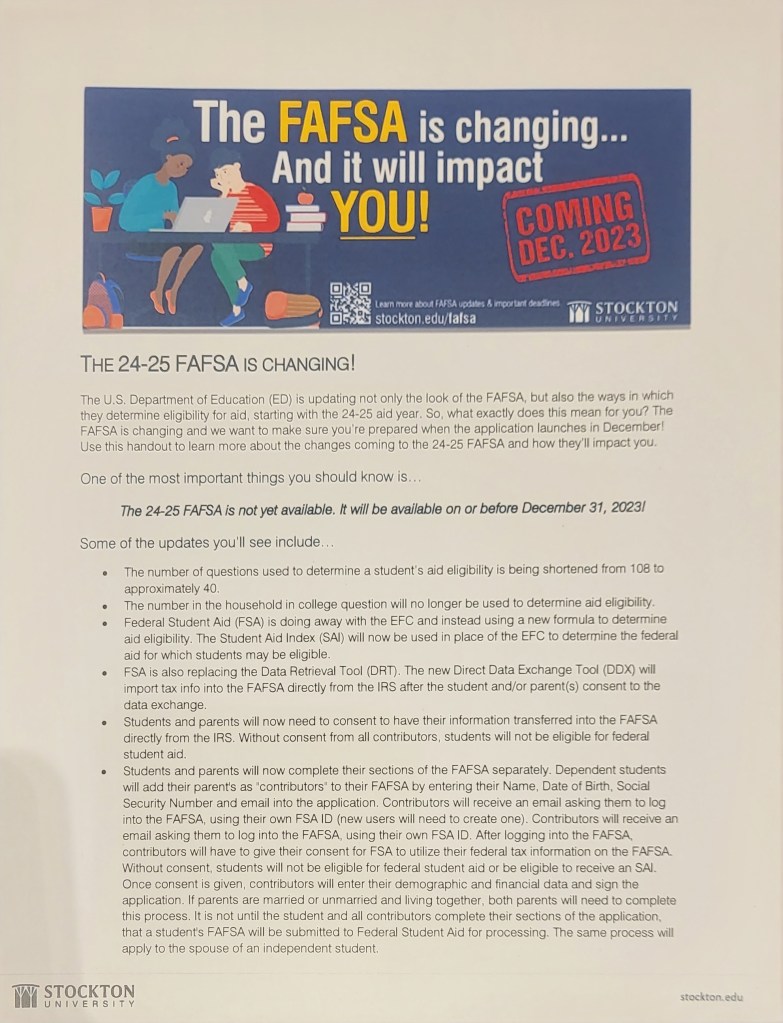
At about this time in the semester, students are expected to have submitted a FAFSA application for the following school year; but the 24-25 FAFSA will be quite different from previous years. With the government making so many changes to the application after decades of the same formula, students and parents alike are concerned about what that means for their financial aid in the foreseeable future. Everyone is asking: what in the world is the new FAFSA?
On Wednesday, November 15, Stockton’s Financial Aid office held a meeting, both in person and on Zoom, to inform students and families about the FAFSA and its changes, and how it will affect students from here on out. If you missed the meeting, worry not! The Financial Aid office has recorded the entire meeting for anyone who couldn’t make it.
The big ‘change’ has been dubbed the ‘FAFSA Simplification Act’ with the goal of shortening the form from approx. 108 questions to approx. 40 and simplifying— as it says in the title— the process of acquiring financial aid for yourself or your student(s). The overall look of the application and the methodology used to determine financial aid will be changed to make it easier for more people to acquire grants and loans, providing a more holistic approach that will bring you the aid you need according to your situation. The government has announced that the new FAFSA will be ready for submission on or before December 31, 2023; while unlikely, this date may be subject to change. The office will update students on any more changes the government may make.
Some changes are popular among students, bringing relief to many at how much easier the process may be. For instance, the EFC (Expected Family Contribution) was previously used to determine your aid eligibility after submitting the FAFSA. This is now being changed to the SAI (Student Aid Index). The lower your SAI, the more financial aid you will receive. Most students will benefit from this change and expect an equal or an increase in the amount of grants and other aid they will receive from the government.
The name was changed from EFC to SAI because many families misinterpreted the number as the residual amount they would need to pay out of pocket. The SAI makes it clear that it is merely an index on how much aid the student is eligible for, not a set number of how much the family is expected to pay after receiving financial aid.
The IRS Data Retrieval Tool was previously used to retrieve your tax information, and for many students, it was a lengthy, confusing process that brought a lot of stress. Thankfully, this tool is no longer being used, now replaced with the Direct Data Exchange (DDE). Instead, your tax information will be retrieved for you. After reading through the information section explaining how your information will be processed, all you have to do is consent to your information being accessed by clicking ‘I Approve’ at the bottom, and everything will be done for you. Please note that without this consent, the student will not be eligible for Federal Student Aid.
The role of the parent/guardian will also be different in the new FAFSA (for dependent students). This will depend on the student’s answers to questions pertaining to their family and their situation. After completing their portion, the student will then add their parent(s)/guardian(s) as ‘Contributors’. You will ‘invite’ your parents/guardians to complete their part of the FAFSA form. After accepting the invitation, the parent/guardian will then answer the same questions as the student using their FSA ID account; if the parent/guardian does not have an account, they must create one.
Another change, which will be available in December, is that parents without an SSN (Social Security Number) will be able to create an FSA ID account.
Before the FAFSA opens, make sure you have your necessary documentation on hand so you can enter your information, which includes:
- 2022 1040’s (Student and Parent)
- 2022 W2’s and 1099’s (Student and Parent)
- Records of Child Support Received (if applicable)
- Current Balances of Cash, Savings and Checking Accounts
- Net Worth of Investments, Businesses, and Farms (if applicable)
A few controversial changes have also been made, one of them being that the number of students in a household will no longer affect your financial aid eligibility. While the FAFSA will still ask about how many college students are in your household for state aid eligibility, this number will no longer be factored into the formula to determine your aid through the FAFSA. This information will be pulled from the parent’s tax return and can be manually updated if necessary.
HESAA (Higher Education Student Assistance Authority), is also adapting to the changes made to the FAFSA. They will still receive the student’s financial information through the application and consider New Jersey residents attending New Jersey schools for state financial aid. Please note that NJ Dreamers will not file a FAFSA; they will instead file the NJ Alternative Application at hesaa.org. The State Aid deadline is still April 15th, 2024.
During the presentation, attendees both in person and on Zoom were able to see a preview of what the new application will look like. Being just a preview, it wasn’t a complete view of how it will be, but it gave attendees a good idea of what to expect when the FAFSA finally opens on or before December 31. It is expected to be much simpler and less stress-inducing than it was before, even changing its appearance to be more visually appealing.
Marielena Dottoli, Assistant Director of Financial Aid and two-time alumna of Stockton, was the presenter at the meeting. Dottoli was equally as excited about most of the changes made since many of them have turned the FAFSA into an easier process for receiving aid. She thought the changes were “long overdue; they haven’t changed the FAFSA in many decades. There are some things we’re going to like, some things we might not like, but definitely a lot of important changes.” At the end of the presentation, she reassured students and families that Stockton would continuously learn as much as possible about changes to financial aid to keep the student body up to date. “We attend webinars all the time, and conferences, to make sure we’re up to date and that we’re doing as much as we can,” Dottoli stated.
For more information on the FAFSA or any information pertaining to financial aid, follow @stocktonfinaid on Instagram or contact the office at (609) 652-4203 for an appointment. You can also schedule an appointment through email at stockton.edu/contactfinaid.
Categories: Stockton News




 stocktonargo.com