
 Allie Agostino
 Iman Ahmed
 Christian Alvarez
 Brianna Barretta
 Kirah D. Cobbs
 Ryan Connelly
 Victoria Corless
 Mary DeRose
 Saira Desai
 Matthew Dietrich
 doogaho
 Dylan Kaminski
 Esmeralda Rivera
 Erin Nevin
 Anthony Bolton
 fourriea
 Jecce H
 jaredkeane
 Sarah Kropinack
 Laura Leonel
 Kayla Lavecchia
 liptack2gostocktonedu
 mary ceceilia
 Matt Cavallo
 Eli Mitros
 Elizabeth Myers
 Tyler Nicosia
 CHARLES OBIRINANWA
 Kollisa Pimentel
 Vincent Rapallo
 Shakila Riaz
 Tori Robbins
 Diamond Rogers
 Kamelea Saitova
 sarahcipkins
 The Argo
 suzannaccook
 Amanda Tague
 Jaedyn Thomson
 Danna Urias
 Breanna Vanaman
 Jennifer Vaneman
 victoriaorlow
 yoneluna
 Zuleika Rodriguez
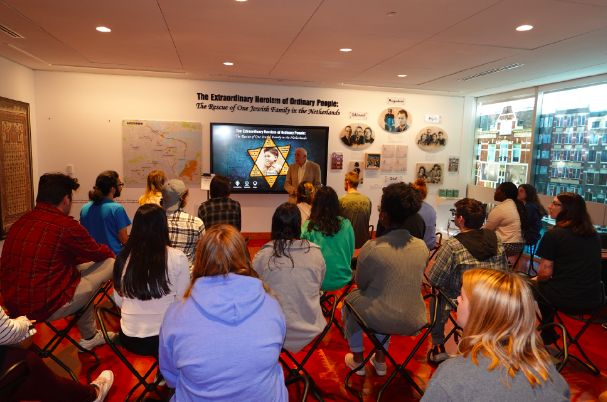
On Tuesday, September 19, 2023, at 2:30 p.m. in the Holocaust Resource Center, Holocaust survivor Leo Ullman visited Stockton University to speak on his experience during the Second World War.
During his speech, Leo Ullman recounted the 797 days, from age three to six, that he had to stay with a separate family, the Schimmels, to hide from the Nazi occupation of Amsterdam. After the war, he was reunited with his family and then immigrated to the United States in 1947. He would go on to serve in the U.S. Marine Corps and then attend Harvard and Columbia University for law and business.
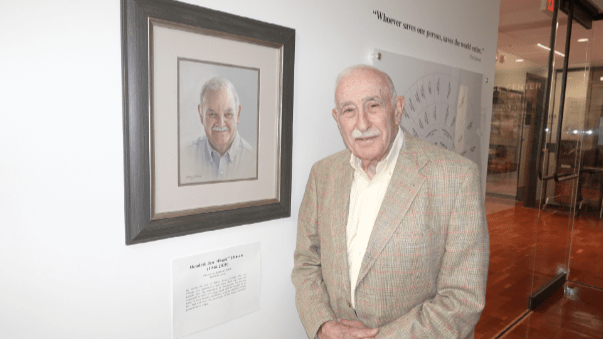
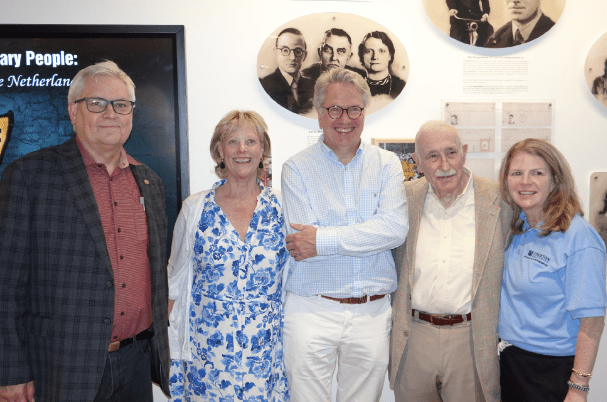
Also in the room with Ullman were the grandchildren of the Schimmel family who protected him during the war. “The Schimmels have stayed in my life, literally to this day. When my parents found me through the resistance, where I was hiding, and came to pick me up, my parents looked awful. They have starved in the attic they were hiding in for over two years. They were in a single room without heat or electricity. Imagine being in a room with your spouse every single day for 976 days” Ullman said.
He continued speaking on his path after the war. “When my parents came to pick me up, I didn’t recognize them. I was three when I left, and I was six and a half when I saw them. I didn’t want to go with them, the Schimmels as—far as I knew—were my parents.”
“When I was in hiding they [the Schimmels] dyed my hair blond and early on would take me out for walks, but eventually I would stay on the third floor of the apartment until it was over, with the exception of when there was a raid. My war-father, Opa Schimmel, was friendly with a German woman who worked in a bar in Amsterdam that was frequented by Germans. Through that connection, she would come to learn when there would be a raid. That was really important. They would ship me out to the home of Anton Schimmel and I would stay there for a few days until the raid was over.”
“There were substantial bounties paid for anyone who would betray a Jew. When the war was over, there was a celebration at the apartment house where I lived. It turns out that not one person on that whole block didn’t know that the Schimmels were hiding a Jewish kid and nobody betrayed us.”
“When we came to America, we didn’t want to be different. It was very important to us to assimilate. I would walk at least 30 feet in front or behind my parents because they had an accent. I never talked about my background. If I told them [Harvard] I was a Jewish immigrant, I don’t think I would have made the clubs I was in. My brother was born nine months after the war had ended. We kept urging my parents to tell their story. My mother, in an adult education course, decided to start writing her story. For their 40th wedding anniversary, which took place in 1976, my mother handed my brother the story of survival that she had hand-written and typed. From that point on, it liberated them, they wouldn’t talk about it until then.”
The final point Ullman mentioned was a map in the room showing that the house that Anne Frank’s family was hiding in was a few blocks away from where Ullman was hiding. They had eight people in hiding who they had to feed every day. They also lacked the connection that Ullman’s family had to provide valuable food and information.
Ullman also came into possession of five pages of the Anne Frank diary and donated them after great effort due to the family never wanting them published because of the way Anne Frank talked about her parents and her development into becoming a woman.
The room that Leo Ullman spoke in was the Stockton Holocaust Resource Center and it is dedicated to telling the story of Holocaust survivors in Amsterdam. When the Holocaust Resource Center isn’t receiving visits from survivors, they are engaged in projects related to education on survivors or providing courses for their Holocaust and Genocides minor program, even offering dual credit programs to high school and international students.
Categories: News and Events, Stockton News



 stocktonargo.com